It is now Monday the 28th of February, and we’d been in Chiapas long enough. El Salvador was beckoning us. Checking out of Mexico was handled through Memo, the harbormaster, for a reasonable fee. He took a group of us around to the various offices and handled the entire process for us. Even so, it took about 3 hours to complete the checkout. The final step was to have the military clear us out. Once the military had finished with their paperwork, we were instructed to leave immediately while they watched us leave.
As it worked out, we were the last of three boats to leave that day, which put us about 2 hours behind our scheduled departure. We had wanted to leave around 1:30 pm but didn’t leave until about 2:45 pm. I know, cruisers shouldn’t have schedules, but we had a day and time we were to meet the bar pilot outside the El Salvador bar, so the schedule was important for this passage.
This was our first time outside Mexico since mid-November of 2021. Friends told us we would be leaving excellent dining behind. According to many cruisers, Mexico has the best food in all of Latin America. Food, both in restaurants and grocery stores, had been very inexpensive in Mexico. Not so, as we moved further south.
Next stop, Bahia del Sol, El Salvador. This was a 2-day passage of about 238nm. It was quite a rough start leaving the bay. We were pinching tight to the wind with a choppy sea, and motor sailing to try and catch up to our buddy boat, Lola. They were another Panama Posse couple we met in Chiapas on a catamaran. Their catamaran was a bit faster than our boat, so they stayed ahead of us the entire passage. We didn’t catch up to them until we got to the meeting point outside the bar.

When we are on a passage, we normally don’t fix food. We snack and eat things we prepare a day or so before the passage. That first evening we ate carrots and celery with the hummus I had made the day before. I commented in the log that the hummus had just a bit too much lemon, but it was really good.
The first night we rolled a lot, so neither of us got any sleep. The next day was not much better, but we both catnapped throughout the day, motor sailing with just the mainsail. The seas calmed down sometime during the next day and stayed that way for the rest of the passage. We did motor sail most of the way to keep our speed up, as we had that schedule to meet the bar pilot for a high tide crossing of the bar. We were scheduled to cross the bar at approximately 2:55 pm on Wednesday the 2nd of March. This bar crossing is somewhat dangerous, so you must hire a bar pilot to guide you across the bar both coming and going. It was $25 each way. Not expensive at all.
The engine stopped around 6 pm that first evening. I thought it was probably a clogged fuel filter as the vacuum gauge on the Racor indicated the filter needed to be changed. The wind was about 10 knots, so we sailed for a while at 4.5 knots. That gave me time to change the filter. I was surprised when I took the filter out as it didn’t look very dirty. I tossed it anyway as I had quite a few spares. I restarted the engine and we continued to motor sail to try and keep pace with Lola.
The engine stopped again a while later and Lynette asked me if our other tank used the same fuel line into the filter. What a great question! I hadn’t thought about the axillary tank, so I switched to that tank, and the engine kept running with no further issues. With Lynette’s brilliant question, we determined we had a fouled main fuel tank, and when the seas were rough it stirred up the gunk in the bottom and starved the engine of fuel. Sometimes it takes another person’s perspective to solve problems.
The axillary tank only holds about 10 gallons of fuel, which wasn’t enough to get us to our destination. After a while, I switched back to the main tank when the seas calmed down and we were able to continue using the main tank. That would change in a few hours, and we were back on the axillary tank. Another item added to our fix list. Note: this issue haunted us for some time until we got to the boatyard in Quepos where they could polish the fuel and clean the tank.
We continued switching back and forth between the main and axillary tanks depending on the sea state. If it calmed down, we would motor using the main tank until the engine quit when it became choppy. Then we’d switch to the axillary tank. We did have to add 5 gallons of fuel to the axillary tank from one of our jerry cans at one point, as we had used up the 10 gallons in that tank.
There wasn’t much in the way of sea life. We did spot some dolphins a couple of times, but that was about it. Marine traffic was sparse as well, except when we passed a commercial port in Guatemala. There were also some fishermen along the way, but we saw no long lines, thankfully.
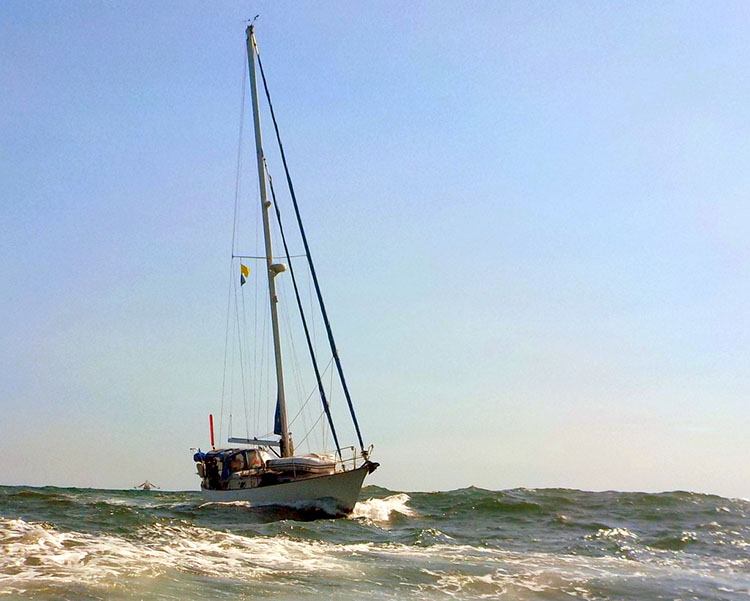
With all the motor sailing, we were able to reach the rendezvous spot for the pilot about an hour early. Lola was already there and had been waiting about an hour. The pilot, via VHF, said we should anchor NW of the rendezvous spot, so we anchored near the shore with quite a strong onshore breeze. This was not a fun anchorage as waves were crashing right behind us. We felt good that our Spade anchor has always set quickly and held well. After about 30 minutes, the pilot radioed us to move to the rendezvous spot, so we hoisted the anchor and motored for about 30 minutes to the spot where the pilot boat was waiting. Lola went first across the bar with no issues. The pilot then came back for us and off we went. The bar crossing was uneventful. No worse than crossing the Columbia Bar on a good day.

We were met at the dock by line handlers and Bill and Jean, an ex-pat couple who helped the boating community in the area. Jean handed each of us a cold cocktail and took me to check in. Lynette stayed with Bill and a couple from the boat next to us (we had met them in Barra along with their 3 kids). Lynette tried to clean up the boat while I was checking in, but she was just too tired. She waited a while for me, and when I didn’t return, she walked up to the pool. There I was, sitting with Lori and Doug from Lola having a $1 beer. She decided to order a margarita.

We knew we were no longer in Mexico when we ate dinner at the resort buffet. It was more expensive than dinners in Mexico and definitely in the category of cafeteria food (think cafeteria lunch in grade school). It did fill the void and satisfied our hunger, though.
We had been using Mexican Pesos for so long that we no longer had any US dollars. El Salvador uses the US dollar as its currency, and without any dollars, we were fortunate that everything we bought at the marina was put on our tab. We didn’t need any money while at the marina.
San Salvador, the capital of El Salvador, is a good-sized city inland from the marina and the only place with large grocery stores to provision. There are several small stores closer to the marina, but we wanted to go to a well-stocked store. We rented a car with our boat buddies and took a day trip to San Salvador. None of us had local cell phone SIM cards, so using our phones to navigate was unpredictable and often nonexistent. What a helpless feeling without Waze to guide us. Our first stop was an ATM. I had left my ATM card in a machine in Chiapas, so we had to use Lynette’s ATM card. She hadn’t used it for many years, so had forgotten her PIN. We finally figured it out and were able to withdraw some cash. I was now feeling a bit less stressed over not having cash.
Doug, from Lola, wanted to find a local cellular store so he could buy a phone to use in El Salvador but first, we were all hungry. We found an Olive Garden at one of the malls, so we ate there. It was a little odd to sail all the way to El Salvador and eat at an Olive Garden, but it was good and satisfied everyone’s hunger. Back to the cell phone issue. Doug found a cell phone store near the restaurant and purchased a local phone. He was finally able to use Waze reliably so we could explore the city and find our way back to the marina. Lynette and I had decided not to purchase SIMs until we got to Panama, as we weren’t going to spend much time in any country before Panama.
We heard from others at the marina that the best grocery store was across the street from the US Embassy, so with Waze guiding us, we found the store. I must say, this store was very well stocked and because of its location across the street from the US Embassy, had many items you would see in US stores. Groceries were noticeably more expensive than in Mexico, but not as expensive as in the US. Speaking of the US Embassy, it is a very large and nice-looking complex of many buildings with very well-manicured landscaping.
On Saturday we went to a gathering at Bill and Jean’s home, with other Panama Posse members, for cocktails and a traditional El Salvadorian food called Pulpusas (stuffed tortillas). This is a weekly event they put on for visiting cruisers when they are available. They sent a panga to pick us up and take us back to our boat, as we didn’t want to launch our dinghy for just one event. We had an enjoyable evening with great food and conversations.

We stayed at the marina in El Salvador until Wednesday, March 9th, and left with Lola and Brisa heading south at 6:30 am. Lola being one of them. The bar crossing went smoothly with no issues for any of us crossing that morning. I could see storm clouds on the horizon, so I used the radar to seek a path with the least amount of rain. We still got a drenching, which gave us time to clean the cockpit.
Because of rough seas and then calm repeating almost the entire trip to Costa Rica, we had to keep switching from the main tank to the axillary tank. We were able to do some sailing. There were some periods of strong winds up to 30 knots on the nose, where we furled the sails, but otherwise mostly motor sailing.
I was worried that we were spending too much time on the 10-gallon axillary tank and that we would eventually run out of fuel. We had 15 gallons of fuel in jerry cans and by the time we got to our anchorage in Costa Rica, we had put all of that in the axillary tank. Every chance I got, I switched back to the main tank for as long as it would keep the engine running, but the engine was continuing to run less and less using the main tank.
Sea life was reasonably abundant. Some turtles and quite a few dolphins passed by. We were usually in the presence of some fishermen with their long lines stretched across our path. We never encountered any but thought we saw some close one night, as there were lights on the water that might have been long-line float lights.
The seas never really calmed down, so we were both a bit seasick. I decided to move closer to shore to see if the seas were a bit calmer and the wind a bit less. We were in luck as we found a smoother patch of water with a bit less wind. Because of our slow headway, often under 3 knots due to the current, we were not going to make it to Marina Papagayo on Friday before dark. I started looking for a good anchorage to overnight, so we could arrive at the marina in the daylight the following day.

I picked what looked to be an easy anchorage very close to the marina, Playa Nacascolo. We arrived at the anchorage around midnight on our third day out. We slowly motored toward shore until we got to about 20’ and dropped the anchor. We were all alone and only about an hour from the marina. We were dead tired. The anchorage was calm, which allowed us to get a good night’s sleep. It was very quiet in the morning as the sun rose until 10 wave runners came roaring by at full speed. A little while later a catamaran arrived and anchored close by. We ate breakfast and leisurely set out for Marina Papagayo around 11 am on Saturday, the 12th of March. We got there in an hour and were tied up within minutes.
Because of COVID, Costa Rica required arriving and leaving boaters to use an agent to check in and check out (this has now changed, and an agent is no longer required). The check-in cost was $450 and the check-out was $200. Quite expensive, and to top it off we were charged an extra $100 for overtime to check in on Saturday. In the many text conversations we had with the agent, he did not mention an overtime fee. If he had told us there would be an overtime fee of $100, we would have stayed on the anchor until Monday and gone to the marina then. We weren’t told, so we suffered the consequences, and he picked up an easy $100.

Marina Papagayo is probably the nicest marina south of San Diego. Everything was in top shape. Excellent pool, showers, and laundry. There was even a very nice restaurant/bar right there. On the downside, the marina was extremely expensive, and it was a $50 taxi ride each way to the nearest grocery store in Playas del Coco. We weren’t in Mexico anymore!
We had dinner that night at the restaurant and the bill came to almost $100! We only had a drink each, two salads, and we split 3 tacos. That was the most expensive meal we had since leaving San Diego by at least double, if not more. Oh well, at least the food was very good.
The next day we discovered we had indeed gotten tangled up in some long lines along the way, but never knew it. We were dragging about 100´ of line behind us. The prop and shaft were heavily tangled with line. Doug, from Lola, came over and we both spent over 2 hours with knives cutting the tangled mess from the prop and shaft. When we were done, the dock was littered with line, swivels, and hooks. What a mess. We also discovered that the Spurs line cutter stationary cutter was missing, so somehow it got broken off.

Sunday night there was a Panama Posse potluck as there were quite a few Panama Posse boats at the marina, including the leader and founder of the Panama Posse, Dietmar. We had a wonderful time with lots to eat and many great conversations. It seems that most Sundays the group of Panama Posse cruisers in the marina do something together. The following Sunday was pizza night. Again, another great night of conversations, pizza, and beer.
We stayed longer than we wanted to at Marina Papagayo waiting for a package to arrive. It kept getting delayed in Costa Rican Customs and the shipping company kept asking for more paperwork from us. The package was supposed to be arriving at a friend’s house in Playas del Coco, with the plan that he was to deliver it to us at the marina. With the cost of staying at the marina adding up and still no package, we decide to move to an anchorage near Playas del Coco, Playa Hermosa. The new plan was to have our friend drive the package to Playa Hermosa instead of Marina Papagayo.
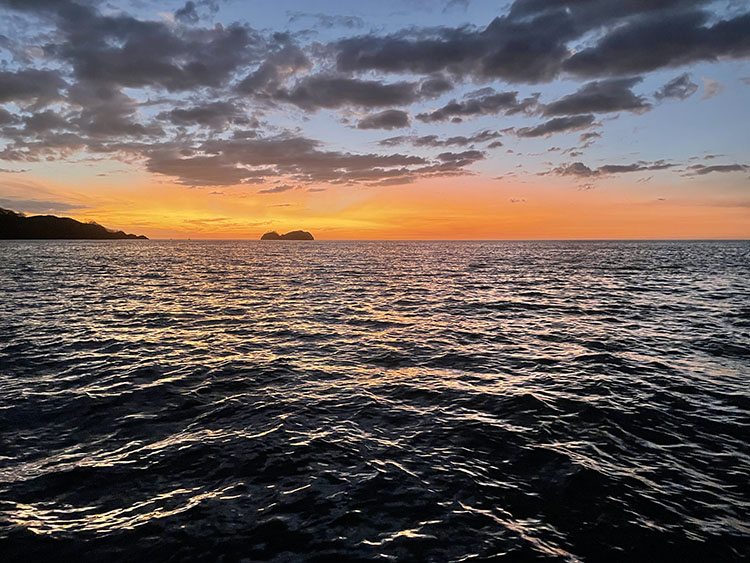
We stayed at Playa Hermosa on the hook for about a week waiting for the package. It never arrived. This beach has a shore break that made it difficult to land our dinghy ashore, so we made a test run with our dinghy to shore. If it hadn’t been for some nice people on the beach helping us land the dinghy, we would have swamped the dinghy. We thanked them and took a much-needed walk along the beach. It was nice to be off the boat and on land for a change, getting some exercise. We also had help getting the dinghy back in the water. Lesson learned; without dinghy wheels, we could not go to shore while at anchor.
After the umpteenth time, the shipping company asked for more paperwork, we finally found someone at the company who could help us with options. The shipping company had an office at our next port of call, Quepos, and we were able to change the ship-to address from our friend’s house to the shipper’s office in Quepos. We were now free to finally move on and not worry about missing our package.
We weighed anchor on March 29th, 2022, in the evening and motored out of Playa Hermosa to Bahia Samara, about 62nm further south. The passage was a mixed bag of motor sailing and sailing on a close reach while fighting a 1.5-knot current much of the way. When our speed dropped to 3 knots, we would fire up the engine. When we could maintain over 3 knots, we cut the engine.
On this passage, we saw some fish doing flips out of the water. We were never able to catch them on camera, so only have the story to tell. We have no idea what kind of fish they were and why they were doing flips out of the water. Some were jumping quite high, 6 to 8 feet out of the water.
We encountered a float off our port side, and we assumed it was part of a long line so took some evasive action to avoid it. It eventually fell off to our stern and disappeared in the night. Hopefully, we hadn’t snagged a line.

We arrived at Bahia Samara in the early morning after a 12-hour passage and dropped the hook. We were tired so slept much of the day. There was some activity on the beach and fishing boats tied up to mooring balls in the bay. Some of the boats were coming and going all day long. We had read that there were a few good restaurants on the beach, but we didn’t want to chance the surf with the dinghy. We left around 8 am the next day in very calm conditions, heading for Marina Pez Vela in Quepos, Costa Rica. This was a 95nm passage, which took about 24 hours.

We had some decent sailing and motor sailing. It rained a bit and we saw our first cargo ship in a very long time. The ship crossed our bow and anchored ahead of us. I assume it was waiting for its turn to go into a nearby port. Our closest point of approach after they had anchored was about 1/4nm. The ship was big and brightly lit up. We also saw some fishermen with long lines off in the distance. Their floats were lit, so it was easy to see where they were. We had read there were fish pens in the area, so these lights could have been the fish pens.
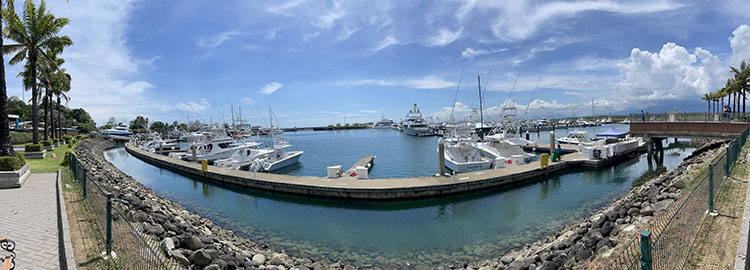
We arrived at Marina Pez Vela before they were open, so we just drifted outside the marina until someone answered our hail. We docked around 6:30 on April 1st, 2022. Check-in was quick and easy. The marina is very nice with restaurants and a small store nearby.
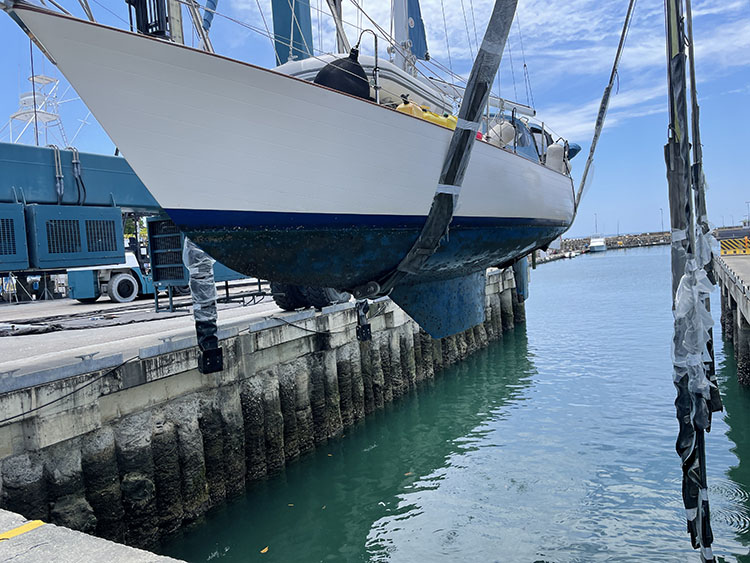
We hauled out the next morning and rented a car along with an Airbnb for the next 10 days. Best 10 days we’ve had since leaving Mexico. We hiked at Manuel Antonio Nature Reserve, ate several dinners at an excellent nearby restaurant, Restaurante El Arado, and swam in the pool at the Airbnb. The Airbnb even had a washer and dryer and air conditioning! It was nice to be off the boat for a while.
During our haul out we had hull damage repaired, the bottom painted, a new depth transducer installed, some voids in the Gelcoat topsides patched, and the fuel polished. They did an excellent job for a fair price that was below their quote. I would highly recommend the Marina Pez Vela Boatyard to anyone needing repairs while traveling in the region.

It was now April 13th, 2022, and we splashed with no issues. That evening we went out for drinks with a Panama Posse couple we had met up with several times in the past, Last Arrow. They had been getting free yellowfin tuna from a fishing boat they were docked next to. They came over after dinner and gave us about 10 pounds of fresh sashimi-grade tuna. Wow! We were in heaven. I immediately cut it into meal-sized pieces and froze the lot for future dinners.
The next afternoon we fueled up and motored out with Bahia Drake as our destination.
 Sailing into our next chapter
This is a magic experience. So beautiful photos!
LikeLike
Glad you like it. We’ve enjoyed the experience.
LikeLike