In our last post, we were leaving Brown’s Marina on Bimini starting our crossing of the Gulf Stream to Florida. I had been watching the weather via PredictWind and saw that the evening of December 15, 2022, looked promising for a smooth crossing. The wind would be light and blowing north, and the passage to West Palm Beach was only 77nm.
A note about crossing the Gulf Stream: never cross if the wind is coming from any northern direction. It causes rough conditions with the Gulf Stream current that can be very unpleasant to dangerous depending on the wind strength.
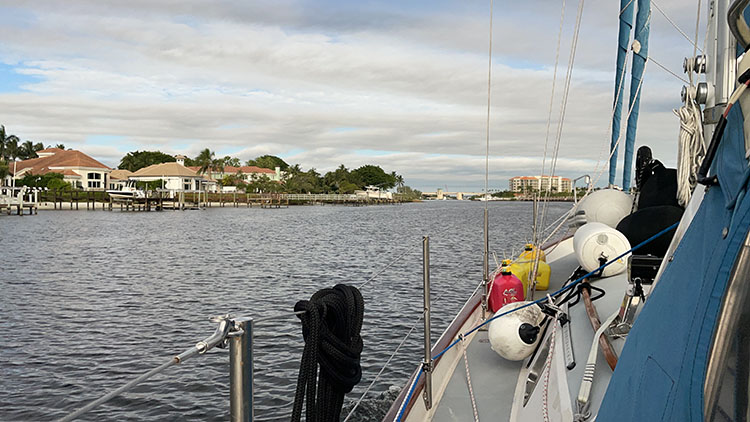
Our crossing was uneventful. So uneventful that our logbook app, Nebo, decided to mess up and not record the entire crossing including all the notes I took along the way. It started recording again, as soon as we got to Florida. Go figure. At some point during the night, we crossed the Gulf Stream, but the conditions were so calm we didn’t know when we had crossed it. We arrived at Lake Worth Inlet near West Palm Beach, Florida, at about 5 am. It was dark and I didn’t want to go through the inlet in the dark, so we floated outside until daybreak and followed a small cruise ship through the inlet. From the inlet, we turned right and headed up the ICW (Intracoastal Waterway) to our reserved slip at Titusville Marina.
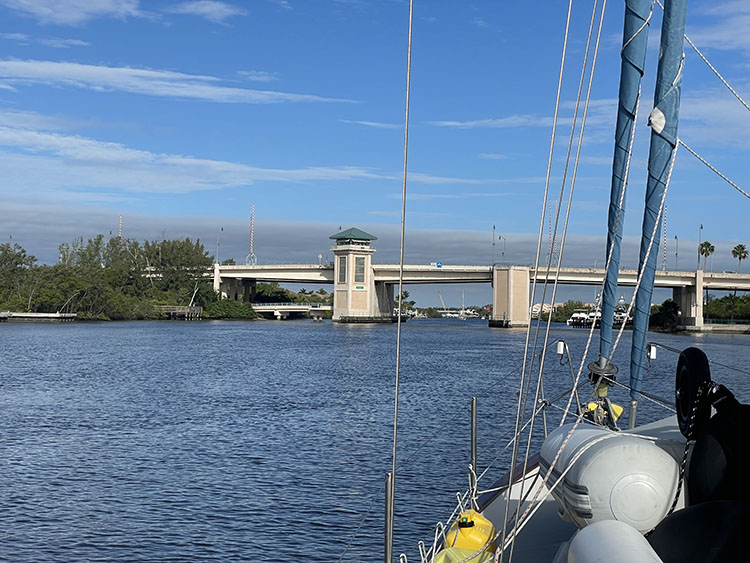
There are two types of bridges on the ICW; fixed bridges that are roughly 65’ high, and drawbridges that require a call on VHF channel 9 for an opening. The drawbridges are bascule bridges that open by pivoting the roadway up from one or both sides. We tested our height under the first fixed bridge by cautiously motoring up to and then under the bridge. From the boat deck, it always looks like you are going to hit the bridge from that viewing angle. We had plenty of room as our air draft is only 59’.
When we arrived at our first drawbridge, we didn’t know the etiquette for hailing bridges on the ICW, so we followed another boat that had just hailed the bridge for an opening. I thought that it only took one boat to call for an opening. We were informed by the bridge tender that all boats that want to pass, must hail the bridge for an opening. A few bridge tenders ask for boat dimensions and others don’t. Some bridges have fixed opening times. These can be on the hour and half hour or quarter and three-quarter hour. Other bridges are open on request. I like those bridges as they open whenever you arrive. For some bridges, we missed the opening time and had to wait half an hour for the next opening.
The southern Florida ICW is quite busy with lots of motorboats creating wakes every time they speed by. The ICW in much of this busy area is lined with expensive homes on each side. Almost all had docks and boat lifts for their motorboats. As we left the more populated areas, the ICW widened with fewer homes along the shores and much less traffic.
We anchored the first night around 5 pm near Fort Pierce by pulling off to the side out of the channel. The only thing to watch out for is the water depth. It can get shallow very quickly once outside the ICW channel. We had gone 47nm since we entered the ICW that morning.
We left the next morning and missed the first bridge opening so had to wait 30 minutes for the next one. Timing is everything. Speaking of timing, we ran out of fuel in our main tank and switched to the side tank for the rest of the trip to Titusville. We hadn’t fueled up since Highborne Key in the Bahamas. We would certainly need fuel when we arrived in Titusville. The day’s passage was uneventful. We timed our next anchorage based on our speed (about 5 knots) and found a nice wide spot in the ICW to pull off and anchor called Honeymoon Bay. We had logged 50.8nm for the day.

It is now December 18, 2022, and we were almost to Titusville Marina. We only had 23.5nm left to reach the marina. The reason we had to go so far north was Titusville Marina was the only marina that could accommodate us for a month. We arrived around 12:30 pm and it was blowing 20+ knots. The slips were narrow and had pilings for the outside corners that were very difficult to negotiate. We did a little damage on our hull trying to get in and it required 4 dock hands to tie dock lines to No Regrets and muscle her into the slip as we didn’t have enough power to turn the bow through the wind to get into the slip. Whew! What an ordeal. I wish it hadn’t been blowing so hard.
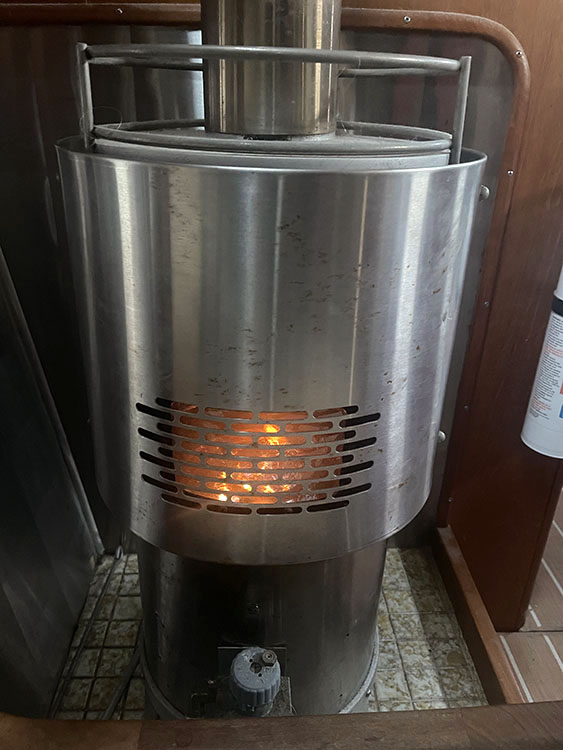
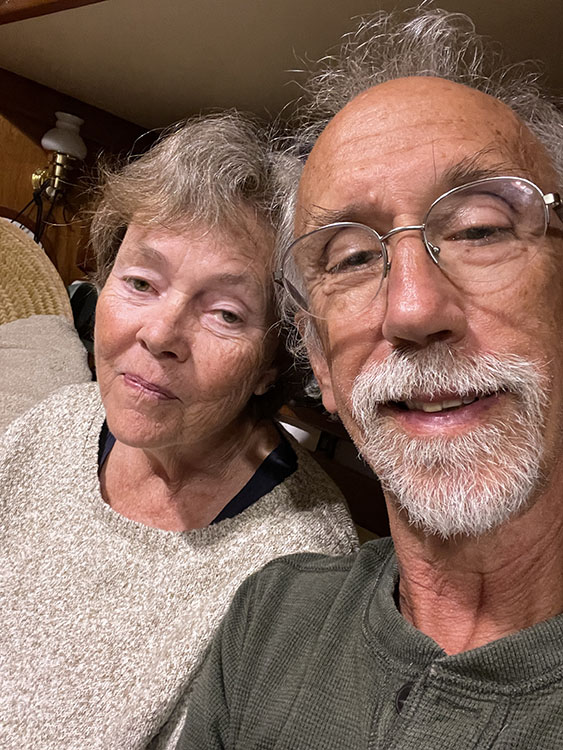
We spent Christmas and New Year’s at Titusville Marina. It was cold, compared to the tropics. We dug out warm clothes and jackets as the nighttime temperatures dropped into the low 30s. We even fired up the diesel heater on several occasions to take the chill out of the boat.
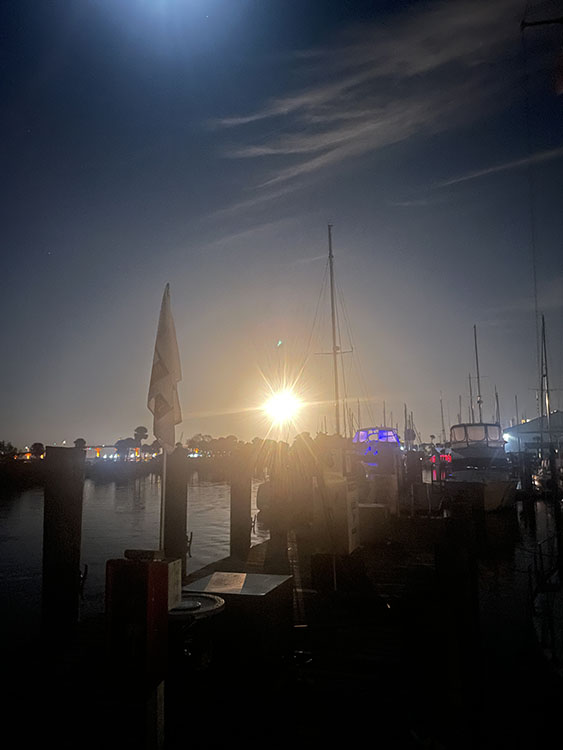
We found out from some marina tenants that SpaceX was going to launch a rocket from Cape Canaveral one night, so we stayed up until 11 pm to watch the event. Neither of us had seen a live rocket launch before, so we were excited to see the event. I noticed a bright light off in the distance and wondered what it was. Within 30 seconds I realized it was the glow from the rocket engines as the rocket was ascending. We were too far away to see anything but the glow. There wasn’t even any sound, as the wind was blowing toward the rocket from us, blowing the sound away. We watched and then saw the booster come back down. It was exciting even though we were quite far away. We found a website that provides information and live coverage of all rocket launches at Cape Canaveral, so found several more launch dates, and watched those launches as well. One was a heavy rocket with two boosters. We could hear the roar of the rockets during that launch, but only faintly due to the distance.
While we were in Titusville, we rented a car to go look at several catamarans that were for sale. We had seen two of them before when we flew up from Panama the previous summer, but we were serious now and were actively looking to replace No Regrets.
We met a couple doing laundry at the marina who recommended a guy in St Petersburg to sell our boat. We reached out to him and decided to take No Regrets to St Petersburg to have him sell her for us. So, on January 22, 2023, we untied the dock lines at 8:40 am and headed south to go around Florida to the west coast.
We backtracked south anchoring at several different places until we reached Fort Lauderdale. This was a 164.2nm passage over 3 days. We took a slip there for several nights as we wanted to see some Panama Posse friends we had met in San Diego. We also met up with the person who purchased my business. He and his wife were spending the winter in Miami and were on their way to meet someone and were passing by Fort Lauderdale, so they stopped by to see us. All-in-all the time in Fort Lauderdale was a nice distraction from the daily grind of motoring on the ICW, and it was great to see both couples again.

We were back on track and heading to the Keys on January 27, 2023. We had to leave the ICW at Fort Lauderdale, as there was a bridge along the way that was broken and could not be raised, so we motored out of the channel and into the ocean. The wind was on the beam so we sailed most of the way to Biscayne Bay, our next anchorage, a 33.8nm passage. It was so nice to not have the sound of the engine for this leg of the trip.

We anchored at Biscayne Bight for two nights, as there was a storm moving through the area. We were across the bay from downtown Miami and the city lights were quite impressive. A good weather window presented itself to get us to Marathon with only a single stop at Rodriguez Key. So, on the morning of January 29, 2023, we weighed anchor and headed west to Rodriguez Key, a 47.6nm passage.

We had the wind on our beam, so we sailed at least half the distance to Rodriguez Key. Rodriguez Key is just a small bit of land that offers some protection from the wind. We tucked in behind the key and dropped the hook in the late afternoon. We find that these short (40nm +/-), day sails suit us much better than overnighters or multiple-day passages. Maybe if we had one more person, it would be less tiring, but as it stands, with just the two of us, we haven’t gotten into a good routine for the longer passages.
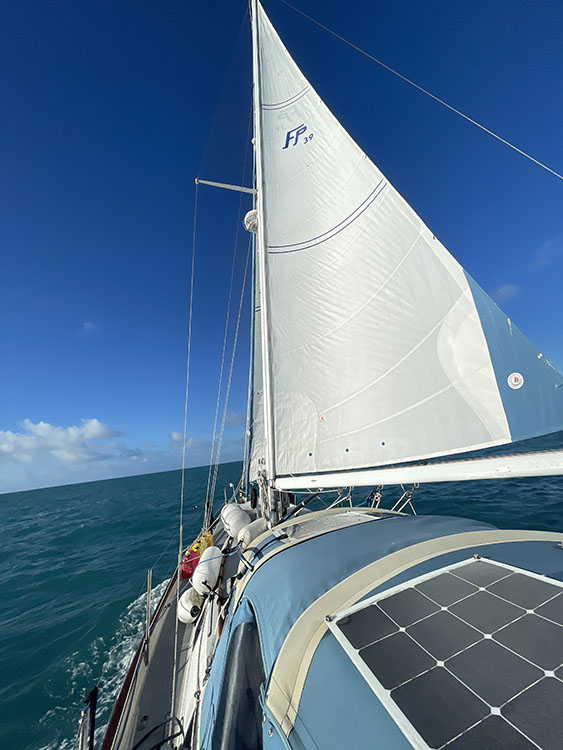
The next day we close reached on a port tack to Marathon, a 44.6nm passage. There were plenty of crab pots to dodge along the way to keep us on our toes. We arrived at 4 pm on the 30th with plenty of time to pick a good spot to anchor. The anchorage was a bit crowded, but we found a reasonable spot in 11’ of water.

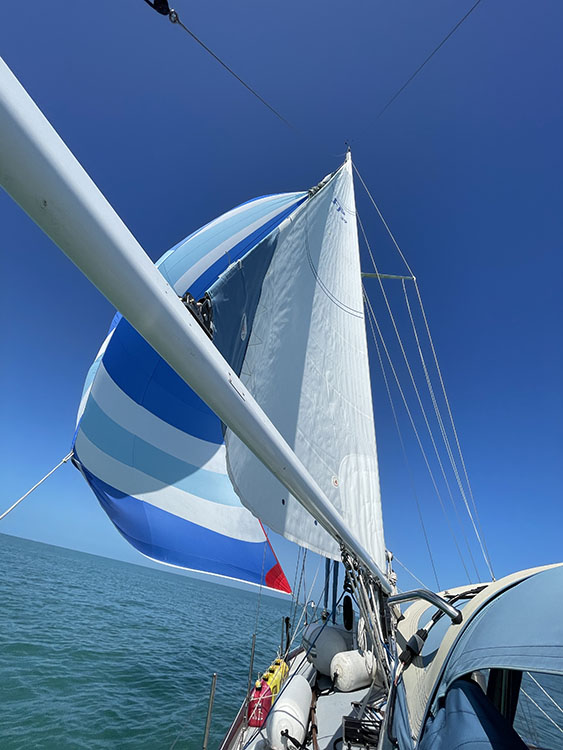
We left the next morning for the longest passage since the Bahamas, 216nm. It was to be our last passage on No Regrets. The passage took two days and we arrived in St Petersburg on February 2, 2023 at 9:00 am. We motored some and sailed some depending on the wind direction and speed. On the first day the conditions were perfect to fly the spinnaker so I set it and had a good run of several hours on spinnaker and main.
Crab pots were plenty and we had been warned by several sailors that Florida Bay was best transited during the day to avoid the crab pots. Each one said the crab pots diminish once you reach Cape Romano, so we were trying to get that far during daylight. I was a little nervous as night fell, fearing that we might snag a crab pot during the night. In the morning we were still sailing so we hadn’t snagged any crab pots. Interestingly, we were still seeing many crab pots north of Cape Romano, which was a bit unsettling as we must have passed many during the night. I shudder to think about it.

Entering Tampa Bay was a bit tricky as there are some keys and shallows at the entrance, so I paid close attention to the charts and depth gauge as we passed the shallows. Seeing the Sunshine Skyway Bridge in the early morning light, was spectacular. After the bridge we turned north toward St Petersburg and the end of this passage. We were dead tired when we arrived at 9 am. Despite being tired, I successfully backed No Regrets into our slip. Then we slept.
 Sailing into our next chapter