
We motored out of Marina Pez Vela at 5:00 pm for Bahia Drake on April 14th. This was an overnight passage where we motored the entire distance as the winds were less than 5 knots. It was nice to have a clean bottom, as we were going 5.4 knots at 1800 rpm with a slight current against us. We did encounter some lightning and rain along the way and tried to dodge as much of it as we could using the radar to find the best path. We were semi-successful at dodging most of the rain, but lightning always scares me on a boat, so we packed up all the portable electronics and put them in the oven. I’m not sure that would help, but it made sense at the time. Luckily, we didn’t get hit (knock on wood) this time.
We passed all the weather by midnight but had to slow ourselves down a bit to arrive at Bahia Drake in the daylight. We were going 5.1 knots at 1500 rpm now, still motoring in light winds. We made it to the anchorage around 5:45 am, just as it was getting light enough to see the other boats in the anchorage. We had no problems anchoring and immediately went to bed for some much-needed sleep.

We spent the next two days in the bay and on the boat the whole time. I wished we had the courage and strength to do more beach landings, but after the near swamping at Playa Hermosa, we realized without wheels on the dinghy, we were doomed to be stuck on the boat while at anchor. Plus, it is quite an effort to launch the dinghy and attach the outboard, then reverse the process when we were done. Even though we were stuck on the boat, it was a nice and quiet anchorage, and a couple of days’ rest was very nice.
We weighed anchor on the afternoon of April 17th and headed to Banana Bay Marina in the small town of Golfito, Costa Rica. This is the last port in Costa Rica and where we checked out of the country to head for Panama. We left in the rain with about 8 knots of wind on the nose, so we were motoring yet again. The seas were lumpy, and winds increased to 20 knots on the nose once we rounded the point. We were making about 4 knots with the engine at 1900 rpm. We weren’t expecting the increase in wind as all the weather models in PredictWind reported much lighter winds. This isn’t the first time PredictWind gave us an inaccurate weather report. We’ve learned to use PredictWind as a good guide, but not necessarily something we can count on for absolute accuracy. The winds did subside in the early morning hours after we were knocked around for many hours and were seasick the entire passage.

It was a welcome reprieve from the rough seas once in the gulf heading toward Golfito. We arrived at Banana Bay Marina on the morning of April 18th at 7:30 am. When we radioed the marina, they said a boat was still in our slip. We had to wait about 30 minutes before we could dock. We decided to anchor out in front of the marina with about half a dozen other boats.
Unfortunately, during the rough weather our anchor chain had tangled in the chain locker so we could only get about 25´ of chain out. On top of that, the windlass stopped working. Issues always happen in multiples. We were able to get the anchor back up but were now stuck in a slight current with other boats anchored close by. Our only option was to motor back and forth in front of the marina waiting for our slip. After about 30 minutes of this back and forth a catamaran owner asked if we wanted to tie up to his stern. We gladly accepted the offer and finally could stop motoring back and forth. The marina called about 15 minutes later and said the slip was ready, so we untied from the catamaran and motored to the slip.
We were finally in the slip a little after 8 am, and dead tired. Neither of us had gotten much sleep during the rough seas the previous night, and we wanted to get some much-needed sleep. That was not to happen as the galley was a mess from the passage. Things on the counter that had never moved on all our passages, had been thrown all over the place. Our eggs all broke on the counter making a huge mess that dripped down into the freezer and refrigerator.
Lynette went to work cleaning up the mess while I took all the tools and supplies out of the V-berth to get to the chain locker. I was able to get the chain untangled and dropped all 400´ into the water to be sure there were no other knots in the chain. I then started troubleshooting why the windlass wouldn’t work. I disconnected the solenoid and foot switch and tested each. The solenoid passed, but the switch didn’t. I took the switch up to the marina office and they said they would find one for me. Two days later they had an exact replacement for the switch. I was amazed one was available in such a backwater place as Golfito. Meanwhile, the chain was still in the water, so I quickly connected the switch and ran the chain back into the locker. Project completed. Cost? About $35 for the switch.
Next, I had to disassemble the Racor turbine filter as the water alarm for the filter had gone off during this passage. That was a messy job as I had to contain all the diesel fuel that was in the filter housing. I sucked it out with a small hand pump into a yogurt container and proceeded to disassemble the filter housing. It was full of gunk that had been in the fuel tank and had clogged the fuel filter. It took some time, but I got all the gunk out including all that was in the plastic bowl at the bottom of the filter. Upon reassembly and testing the alarm was still sounding, so I assumed that after enough fuel had run through the filter the alarm would clear itself. Luckily, I was right, because after we left Banana Bay Marina and had motored for a bit the alarm stopped sounding.
Golfito is a very small town that is the southern port of entry in Costa Rica. It doesn’t have much to offer except a rather large duty-free zone at the end of town. The town was once a company town for a big banana export company. It existed for the company workers. After many years the banana company went out of business leaving the town with no place for the people to work. The duty-free zone has brought business to the town and work for its people, but I’m sure many left to look for work elsewhere.
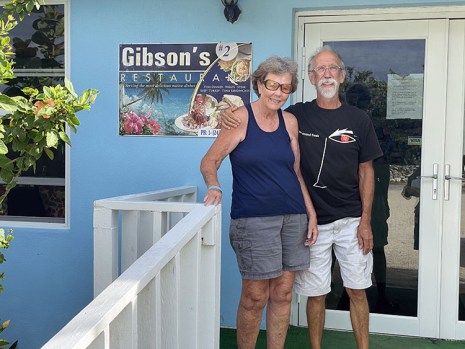
We were able to stock up on some groceries and purchase fuel at the dock. The restaurant at the marina was convenient and served reasonable food. What we noticed about Golfito is that even though the people were friendly and very helpful, the vibe wasn’t the same as up north where there is a heavy tourist focus. No one ever said “Pura Vida” to us in Golfito, whereas up north almost everyone said it. Prices were also much more reasonable in Golfito than up north, where they were inflated to take advantage of the tourist traffic.

We left Banana Bay Marina on April 23rd, at 6 am, after being there for 5 days. Our next port of call was Boca Chica, where we would check into Panama. We had decided, after the rough passage to Golfito to not do any more night passages, so we broke up this passage with two stops along the way, both daytime passages of less than 60nm.
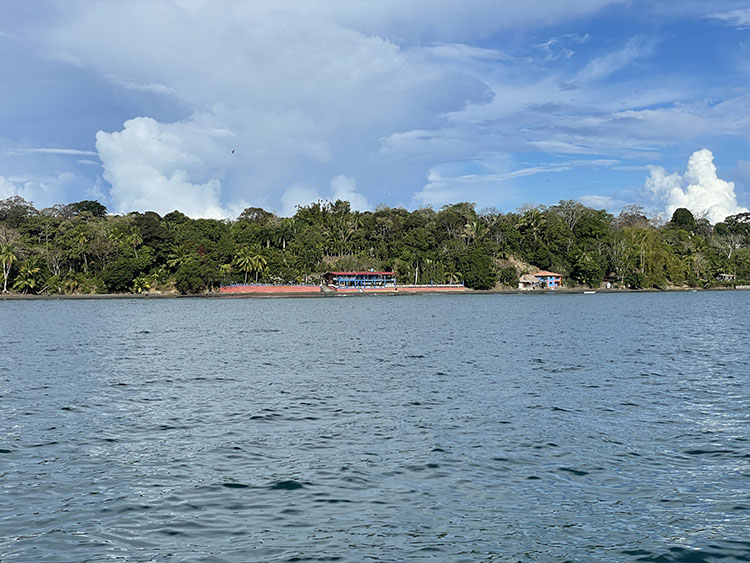
Our first stop was Punto Balsa, about 54nm. We arrived around 5 pm. The cruising guides said to anchor near the house with the red roof. We did just that. This was our first anchorage in Panama The time change from Costa Rica to Panama screwed up our timing, but we were still able to anchor before dark. The passage was about as uneventful as it could be. Light wind for most of the passage, so we motor sailed most of the way. The wind finally picked up when we rounded the point, but we were so close to our anchorage, that we dropped the sails and just motored in. It took a couple of tries to anchor, but we finally got it to hold.
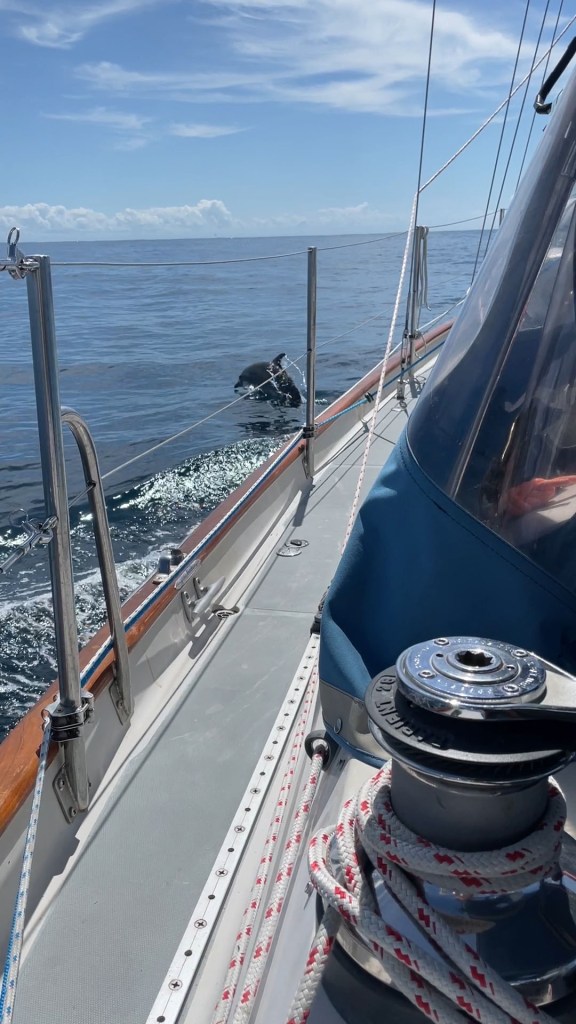
The next day, Sunday, April 24th, we left at 8:45 am and headed to Isla Parida about 35nm away. We were motoring with the breeze on our nose as usual. This was a very calm passage. We saw a few dolphins and turtles along the way that kept our eyes on the water looking for more sea life. We anchored in about 12´ of water at 3 pm. We wove between numerous small islands to arrive at this very protected and secluded anchorage. It was a very pretty place to anchor.

We weighed anchor the following day around 8:20 am and headed for Boca Chica, a short 14nm passage. Boca Chica is an out-of-the-way stop, but the only northern port of entry to Panama. The passage weaves between small islands and reefs that we had marked on our chart plotter. There isn’t much to the town and very little to do in Boca Chica.
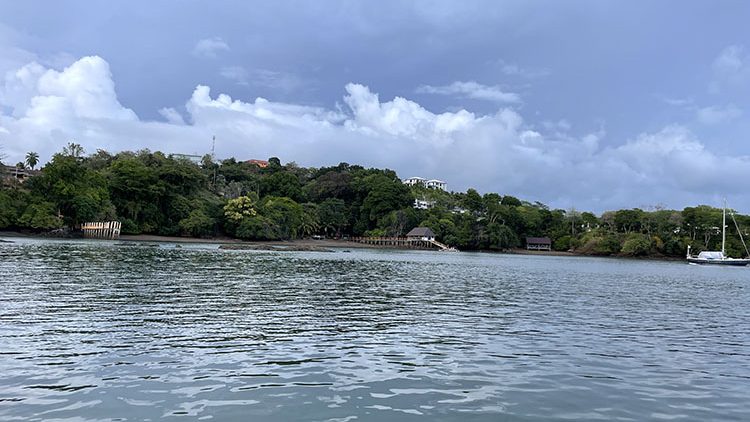
We anchored around 11 am in 33´ of water. After we had settled in, we launched the dinghy to travel the 1.5 miles to check in. We couldn’t get any closer to the dock as there is a power line that goes over the water that is too low for our mast to fit under. We checked in using an agent named Carlos for a fee of $90. We contacted him via WhatsApp ahead of time and arranged all the paperwork electronically. It was a short dinghy ride to his dock. Since the paperwork was already done, it was simple and took less than 2 hours (we had to wait for a couple of the officials to arrive at his house).
The next day Carlos’ son-in-law took us to David, the closest city to provision so we could buy Panamanian SIMM cards for our phones. We had decided not to get new SIMM cards until we reached Panama since we were going to be in Panama for about 6 months for hurricane season, thanks to our boat insurance policy. We also purchased a small bullet blender as we had gotten hooked on fruit smoothies while we were in Costa Rica and wanted to make our own onboard.
Since we had decided to do only day passages, we broke up the trip from Boca Chica to Marina Vista Mar into 5 stops. We planned to stay there for several months before making the transit through the canal. We were also watching the weather quite intently as the passage around Punto Mala has a history of being rough. There were reports from other Panama Posse cruisers about how bad Punto Mala was for them, so we weren’t looking forward to that part of the voyage.
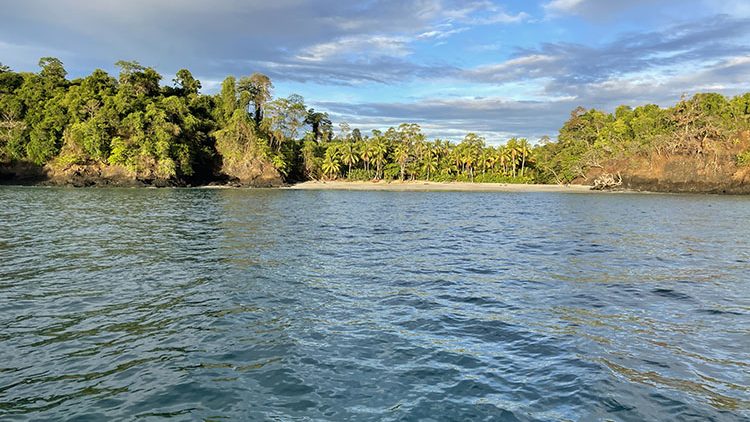
We weighed anchor and left Boca Chica for Isla Secos on April 24th, at 10:15 am, a 19.5nm passage. We followed our incoming tracks as we left. Once out of the small islands and reefs we turned left toward Isla Secos, a small archipelago of 4 islands. We decided on an anchorage at Isla Pargo that wasn’t very well protected but made for easy anchoring. There was a single panga in the anchorage until sunset. We were all alone after they left. The anchorage was a bit rollie, so our sleep wasn’t as nice as we would have liked.
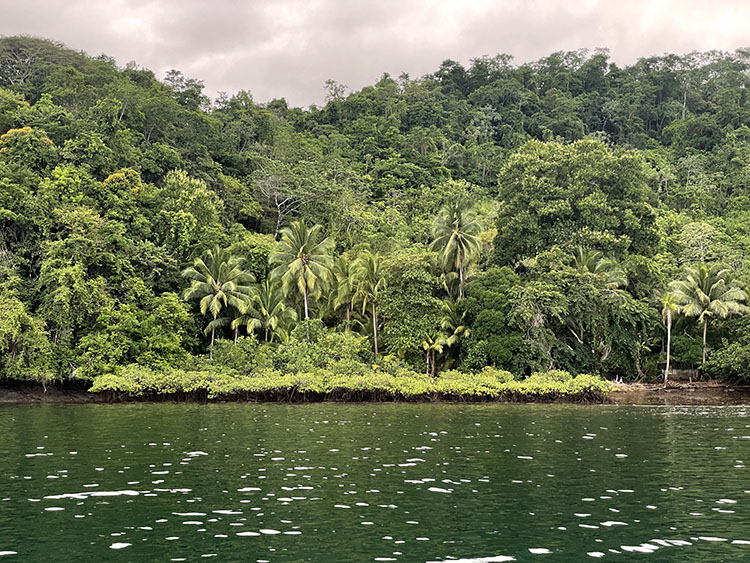
We departed Isla Pargo for Bahia Honda at 7:40 am on Friday, April 29th. Bahia Honda is a nice, protected bay with many favorable comments in the cruising guides. This was a 36nm passage. We opted to anchor near the home of Domingo, called Domingo’s Anchorage. He is a very friendly older man, who comes to your boat on a panga to trade fruits and vegetables for things he needs. No money, please. He doesn’t speak English but does a very good job of communicating. We traded toothbrushes, batteries, olive oil, and cookies for pineapples, mangos, papayas, and bananas. He also offered eggs and chicken, but we declined as we didn’t need either. I think he got the better end of the deal, but it was nice to work through the communication process with him.
He had his grandson (our assumption) driving the panga and he didn’t say a word until we had difficulty understanding that he wanted cooking oil. Seeing that we were struggling to understand Domingo, his grandson said two words, “Cooking oil”. We all laughed as we had no idea he could speak English. He had just let us all struggle with trying to communicate up until that point. Domingo was very excited about the cookies. It was just luck that we had some to give him. He had also wanted fishing line and hooks, but we had neither. This is what cruising is all about. We thoroughly enjoyed the encounter with Domingo and his grandson.

The anchorage was extremely calm. We were able to get an excellent night’s sleep, as we were needing to leave early the next morning. We weighed anchor at 5:45 am on Saturday, April 30th, and headed toward Bahia Arenas, 50nm away. We left on a falling tide and were able to do a bit over 5 knots at 1700rpm. Once outside the bay winds were light so we mostly motor-sailed the entire passage. We attempted to sail once, but with so little wind we decided to start the engine again and motor sail again. We were doing 5.5 knots at 1600rpm, so I wasn’t going to complain.
The wind picked up to about 8.5 knots on the starboard beam, so we killed the engine and were able to sail for about an hour. I’ll take sailing any day over listening to the noise of the engine. This passage was a great example of our sailing experience on the west coast of the Americas; sail a little, motor a lot.

We anchored at Bahia Arenas at 3:45 pm on April 29th in 20´ of water. It was a calm anchorage with only a slight roll. We saw this anchorage as a way to break up the passage from Bahia Honda to Punta Guanico into two daytime passages as opposed to an overnight passage. We were able to relax, eat, and get a good night’s sleep.
We left Bahia Arenas at 5:45 am on April 30th with PredictWind indicating a possible bumpy ride to Punta Guanico. Our autopilot decided to stop working so while motoring we had to hand steer. The wind picked up, so we killed the engine and engaged the Hydrovane to take over steering, a nice break for us.
AIS is such a great bit of technology. We were able to identify a sailing vessel coming toward us as Easy Breezy, so hailed them on VHF. They were heading north, and we were heading south, so we had a nice chat about the weather and places to stop along the way.
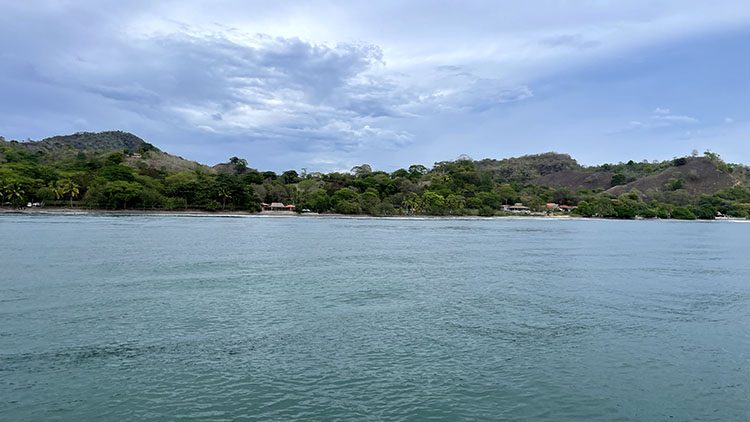
The wind picked up and it looked like it was going to blow even harder, so we furled the sails and went back to motoring. Shortly after that, we encountered 25+ knot winds with very bumpy seas. We were glad we had furled the sails. We rounded the point and started looking for a spot to anchor that was reasonably protected from the wind. We wound up tucking in as close to shore as we could get and set the hook in 20´ of water at about 3:10 pm. It wasn’t the best protection and we thought we’d be in for a rough night, but shortly after anchoring the winds died and the sea calmed down. Another sailboat came in a bit later and anchored behind us. Oddly, we were hailed on our VHF by someone on shore. He was from the US and was curious about who we were. We talked for a bit. He had a tourist fishing business and was in Panama for half the year and then back in the US the other half. It was fun to share our situations and nice to have someone new to talk with.
Next stop, Isla Iguana. We weighed anchor and left Punta Guanico at 5:45 am on May 2nd. Although Isla Iguana was only 33nm away, we decided to give ourselves plenty of time, as we didn’t know what Punto Mala had in store for us. We could have heavy winds, strong opposing current, or both. As we approached Punto Mala we kept close to shore to avoid any strong current, and kept the sails furled, choosing to motor just in case. We were lucky. There were no strong winds or current. It was a very easy passage and we arrived at Isla Iguana in time for lunch at 12:30 pm.
The cruising guides indicated that Isla Iguana was a day anchorage with a reef between the anchorage and the beach. Plus, the anchorage was 50´ deep. I reached out to a cruiser who had overnighted there to get first-hand information on spending the night. He indicated that it was ok if you could get the anchor to hold. We attempted to anchor but never got the anchor to hold, so decided this would be a lunch break for us. I didn’t want to risk an overnight stop with the anchor not holding well, so we would continue to Marina Vista Mar that evening. Yes, we broke our rule and decided our only option was to do an overnight passage. Having decided that, we took a nap to be well-rested for the overnight passage.
The beach at Isla Iguana was very pretty. It was also very crowded with many small boats anchored inside the reef, and many people playing on the beach and swimming. We were surprised by how noisy it was with boats coming and going and kids making noise at the beach. By 3:00 pm they were all gone leaving us alone anchored outside the reef. Quite a sharp contrast to the noise of earlier. The only noises now were the birds. Isla Iguana is a wildlife refuge, and there were many birds on the island and in the air.

We left Isla Iguana at 5:30 pm with plenty of time to arrive at Marina Vista Mar during daylight. This was a 52.4nm passage and we planned for an early morning arrival at the marina. With the autopilot still broken we hand-steered while motoring. This gave Lynette a chance to practice steering to a compass heading. It was good practice and she did great! It seemed strange to see the sunset on the port side of the boat. We had always watched it set on the starboard side, but since Panama lies east and west we were heading almost due north. This is our first time traveling north since we left Oregon.
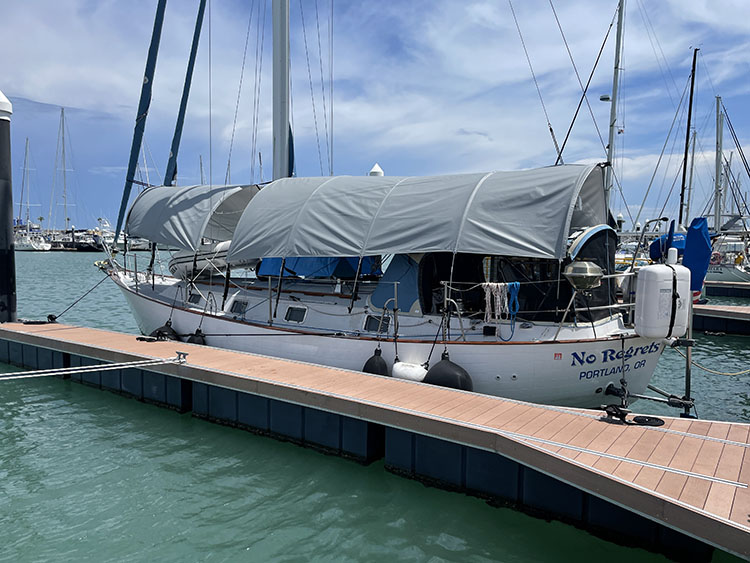
I made coffee to stay awake and we both enjoyed talking about events in our pasts. We motored until 10:30 pm when the wind decided to cooperate. This gave us a break from hand steering as we could use the Hydrovane wind vane to steer. We were close reaching on a port tack at 3.8 knots in 9 knots of wind. A nice, quiet, and easy sail. The wind died down to 5.5 knots. We were now sailing at less than 3 knots. Normally I would start the engine and motor sail to keep the speed up, but we needed to keep a slow pace to arrive at the marina after daybreak. We alternated between motor sailing and sailing as the wind varied. We arrived at the Marina Vista Mar fuel dock at 7:00 am on April 3rd. We topped off our fuel tank and took a slip. We had arrived, safe and sound.
 Sailing into our next chapter