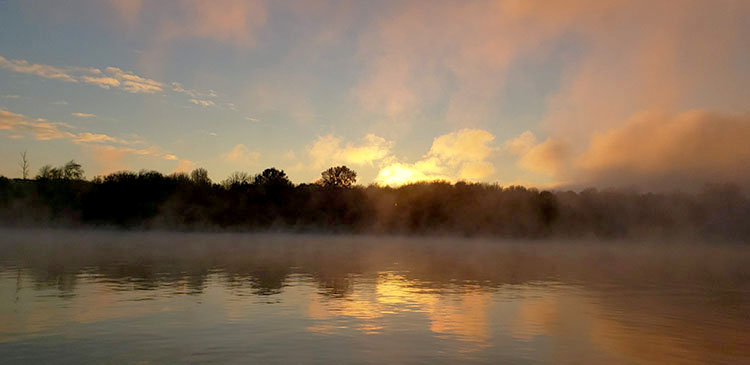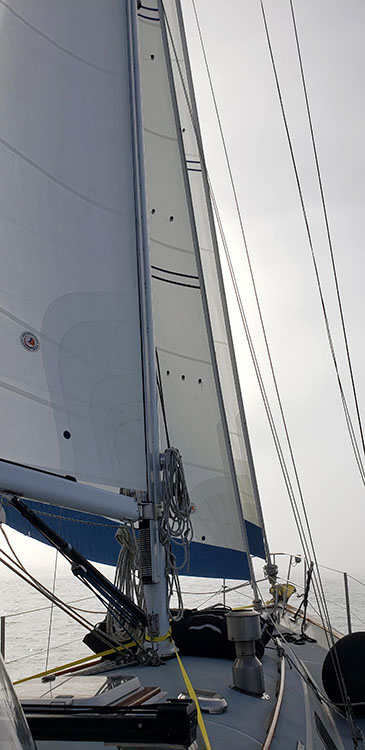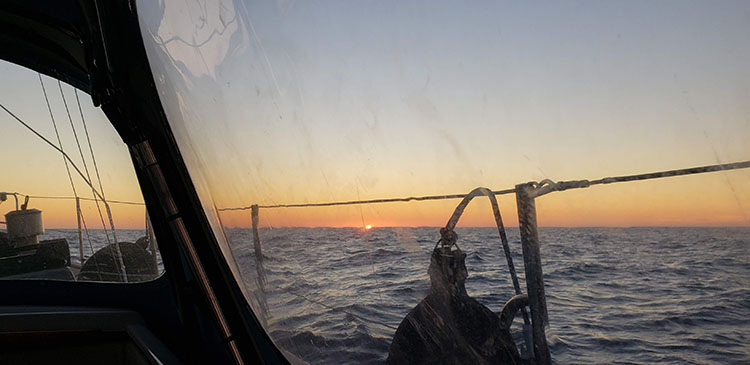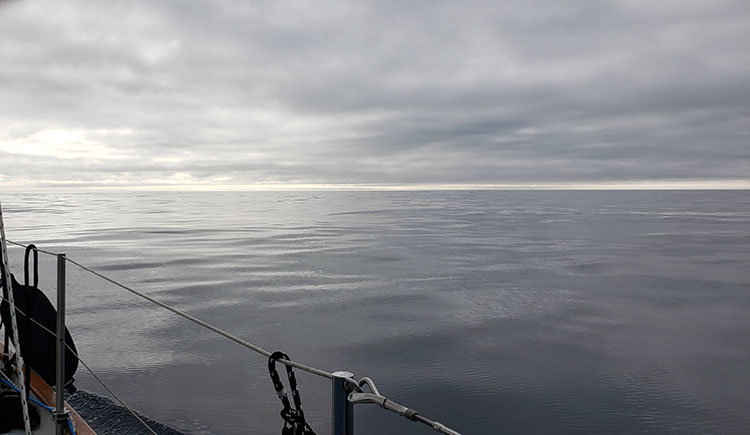
Shelter Bay, Panama to Port Antonio, Jamaica – Fall 2022

September 10, 2022, had been a long day but we were finally done with the Panama Canal transit. After showers and a burger at the marina restaurant, we walked back to the boat and were faced with a total mess in the galley. There was pasta sauce all over, pans that needed to be cleaned, and dishes that were left by the 7 of us (the two of us, 4 line handlers, and the canal advisor) that had eaten breakfast and lunch. What a mess, and to top it off we were tired as we’d been up since 3:00 am and it was now about 7:00 pm. We decided to leave the mess until morning and went to bed.

During the canal transit, our starter battery finally failed. I had known that it was on its last legs for a while, as the starter was getting slower and slower each time I started the engine. By the time we arrived at Shelter Bay, the engine would no longer turn over and I had to switch to the house battery bank to start the engine the last time I started it. This was just one more thing to add to the growing fix-it list.

Over the next week, I looked into finding a replacement start battery. I tried to get one locally and what was available didn’t quite fit our configuration, so I ordered one from the US. The marine chandlery we used has a regular shipment that comes to Panama, but I missed the boat by one day. There is only one boat per month to Panama, so our new battery had to wait for the next boat the following month. This meant we wouldn’t receive the battery until the end of October.

I didn’t want to use the house battery bank to start the engine for fear of damaging those batteries, so the boat sat as we waited for the new battery to arrive. Part of me wished I had purchased a local battery and not waited for the exact replacement battery. Waiting for a battery caused us to miss out on exploring the east coast of Panama as we had planned. We missed going to Bocas del Toro and the San Blas Islands. Kind of a shame, but they are still there, and we can always go back to explore these areas.

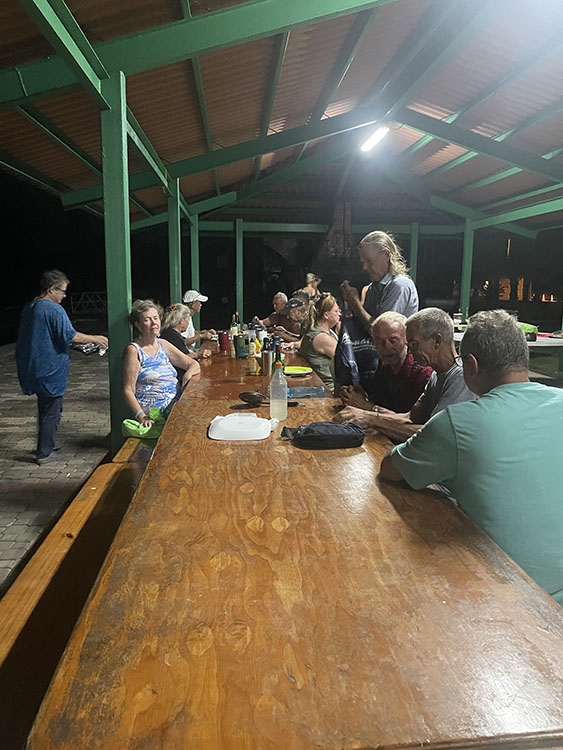
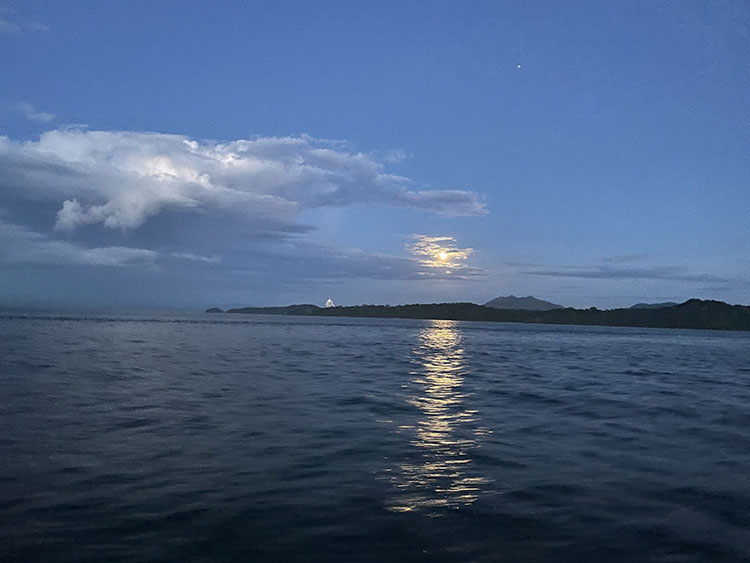
Moonrise during potluck at Shelter Bay
Sunday potluck at Shelter Bay

Meanwhile, there was the fix-it list that needed to be addressed, so we started working on reducing the size of that list. The night before we transited the canal there had been a very heavy surge at the La Playita Marina causing one of our line chocks to break off the toe rail. This needed to be repaired, but before I reinstalled the chock the entire toe rail needed a few more coats of finish. After several days of putting polyurethane on the toe rail, it was finally ready for the chock to be reinstalled. Reinstalling the chock was an easy task, as I had the correct size and length screws to reattach it. Even though we carry a very good supply of nuts, bolts, screws, and washers on board, I usually don’t have the right size for the job. It was a pleasant surprise that I had what I needed.

Jam session at Shelter Bay

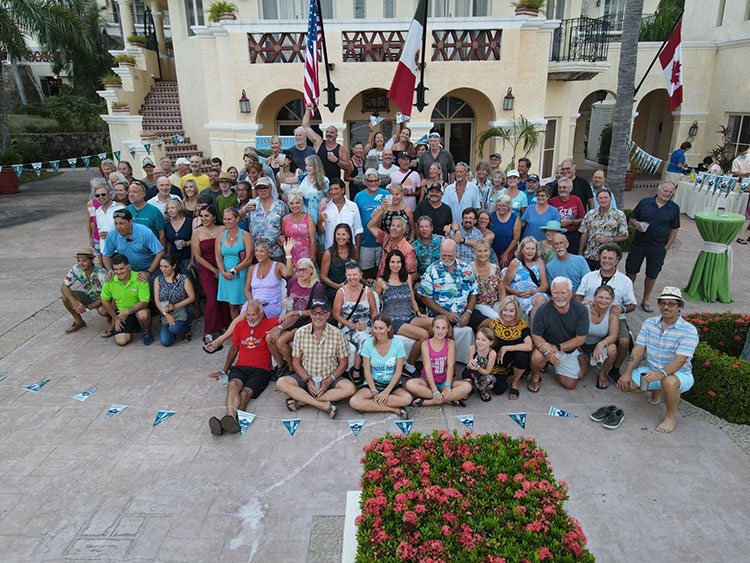
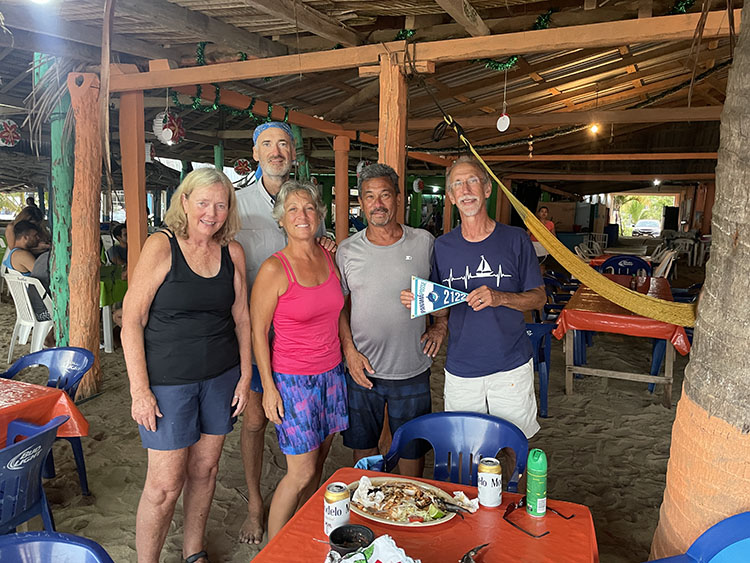
We enjoyed our two-month stay at Shelter Bay Marina. Shelter Bay has a great cruising community that is quite active. We had potlucks every Sunday. You bring a dish to share, something to throw on the grill, and your own drinks, then sit down and enjoy great conversations with the other cruisers that are at the marina. We also participated in Happy Hour every Wednesday with snacks to share and our own drinks. There were nature walks, free bus rides to town for supplies, and music jam nights. All quite fun and this made our stay both memorable and enjoyable. The time flew by.
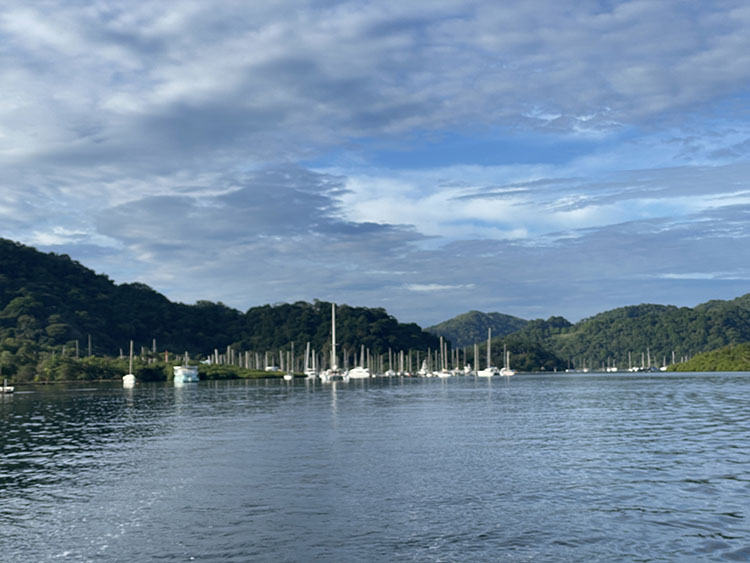
Linton Bay

We had met a family in Barra De Navidad who were now at Shelter Bay Marina. The family consisted of mom, dad, three kids, and a dog on a 37’ catamaran named Kyrie! They were doing some repairs on their boat and getting ready to head toward the US. We were heading in the same direction, so we decided to buddy boat. When all the projects were almost done, and our starter battery had arrived we started watching the weather for a favorable window. We left on September 8th in the morning for a 29nm run to Linton Bay for Pizza, Beer, some fuel, and an overnight anchorage. The next morning, we headed to Guna Yala (San Blass Islands) to overnight at the swimming pool. We grounded twice trying to get close to Kyrie but could not find a way around the sandbar. They have a shallower draft, so could anchor in much shallower water. We finally found a way around the sandbar and anchored reasonably close to them.

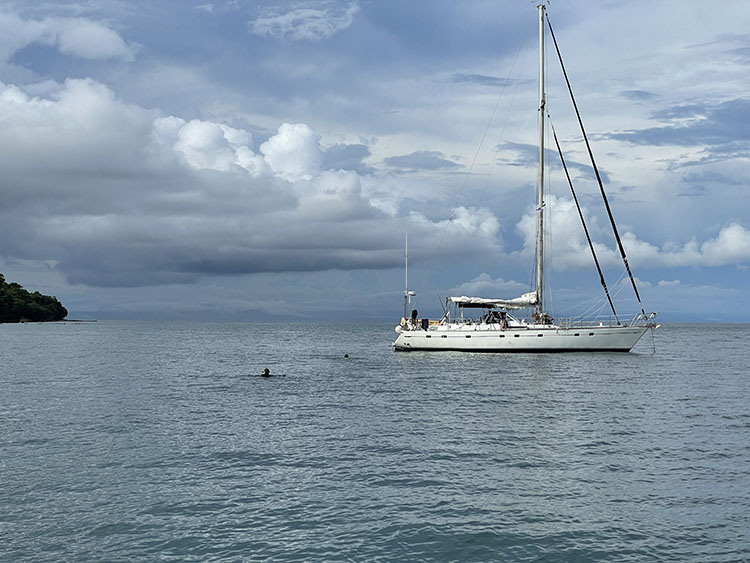
Kyrie anchored at the Swimming Pool, San Blas Islands

The next morning Kristen and Joe came over to discuss our next passage and have coffee. The plans were made for the day; we would leave in the afternoon as there was concern the weather window to Jamaica wouldn’t hold. Meanwhile, being anchored in crystal clear water I decided to try out my homemade hookah and clean the bottom of the boat. It was a tiring task that left me quite exhausted after several hours of cleaning. The hookah was a great success, though. Lynette went for a swim in the warm, clear water while I was busy cleaning the bottom.
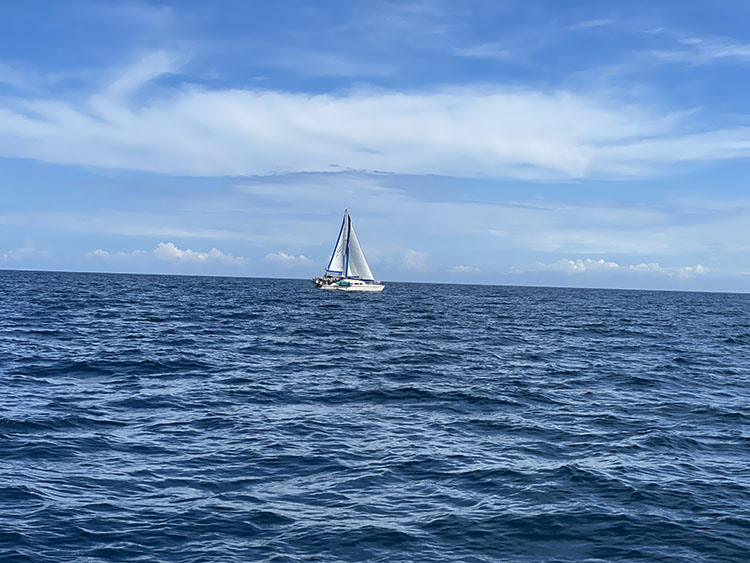
Kyrie on passage to Jamaica

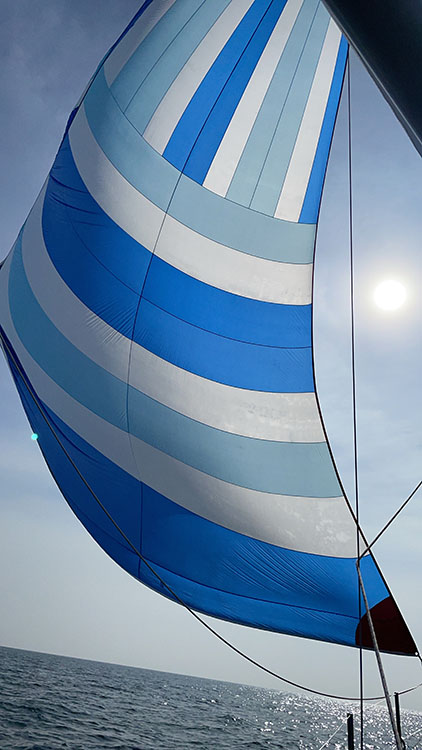
That afternoon before dark we took off for Jamaica. This was to be our longest passage, taking 6-7 days.  It was a great afternoon for the spinnaker with the wind on our starboard quarter at about 160º. We were able to attain speeds up to 8 knots while only flying the spinnaker. As night fell, I decided to leave the spinnaker up as the wind was calm. I should have doused the spinnaker when it got dark, but we were making great headway, so we left it up. That was a mistake, as the winds died in the middle of the night, and we were plagued with a beam swell that relentlessly rocked the boat. We were now motor sailing with the spinnaker lashed down to keep it from getting damaged. It wasn’t until the next morning that we were able to douse it and stow it below. Just as we finished stowing the spinnaker we were hit by a squall. It was short-lived, and we spent that day fighting low to moderate winds, going back and forth between motor sailing and sailing depending on the direction and speed of the wind.

We had planned to go east as far as Santa Marta, Colombia, along the Colombian coast, and then turn north to Jamaica, but the seas were getting rough, and the wind was increasing from the east as we moved through the night. Finally, Kyrie turned north ahead of schedule as they couldn’t handle the pounding in their catamaran. We followed a short time later. This was to be our second mistake and it was a big one; not easting far enough to make it to the eastern end of Jamaica.

Catamarans notoriously do not point well to weather, meaning they can’t sail as close to the wind as we can. As time passed over several days, Kyrie slipped farther and farther to the west and clearly couldn’t make it to the east end of Jamaica. They finally decided to go around the west end of Jamaica, with Montego Bay as their destination. They were hoping to only stay there for a short period until the weather allowed them to join us at Port Antonio.

The seas were bad for the next 4 days, not calming down as long as the wind was blowing. According to Predictwind, the winds were supposed to slowly clock around to the east, but they only did for a very short period. The wind continued to blow predominantly from the ENE, preventing us from making much-needed easting to pass around the east end of Jamaica. As Kyrie was sailing farther and farther west, we were also moving a bit too far to the west. During one of the days our autopilot stopped working so we were left to hand steer while motoring. Luckily the wind was blowing well, and when it wasn’t on our nose, we were able to sail and use the Hydrovane to steer the boat, giving us a break from hand steering. Kyrie and I stayed in touch via our Iridium GO and their SSB radio using email so we could update each other as to our conditions and plans.
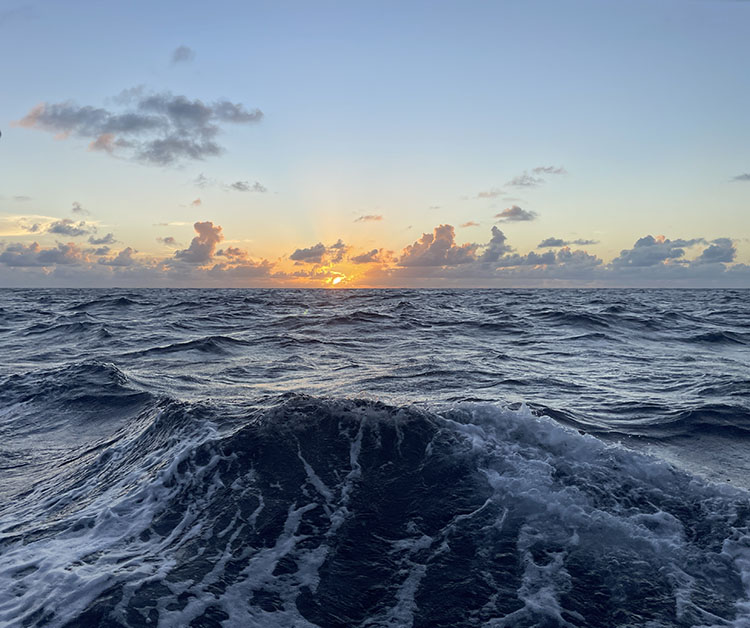
Rough seas on the way to Jamaica

By the 4th day we realized that we would not make the east end of Jamaica, so decided we should follow Kyrie and go with the wind to the west end of Jamaica. That decision had also been prompted by the fact that our fuel problem had reared its ugly head again and the engine wouldn’t run in the choppy seas. It would be necessary to change the fuel filter and I wasn’t about to go below and do that while the seas were tossing the boat around like a cork. I had. Been seasick much of this passage, and a trip below would have been disastrous. And to add to our dilemma, the winds continued to come from a more northerly direction, now almost out of the NE. Without an engine, there was no way to gain any more headway to the east. Turning west was our only option, so we turned and headed west under sail.

During one of my cat naps in the middle of the night, I woke to flapping sails (I always set a 15-minute alarm to wake me so I can look around). The wind, after all this time, decided to die. I mean dead. No wind, period, and without the engine, we were just bobbing on the water. Now that the wind was gone, the seas started to calm down and I was able to go below and change the fuel filter. The engine started right up and with no wind, I made a command decision to turn the boat around and head east. We had only gone west about 5 hours, so had to backtrack that same amount to get to where we had originally turned west.

We continued to alter between sailing and motor sailing as we headed east. The wind was mostly on our nose, or close to it. Along the way, a Jamaican Coast Guard vessel came alongside and asked where we had come from and where we were going. We said Panama and Port Antonio. They thanked us and sped away. We rounded the east end of Jamaica expecting a bit of a breeze to push us the rest of the way west to Port Antonio. No such luck. The wind died and we motored to Port Antonio.

It is now the 16th of November, and without wind, we wouldn’t make the marina before dark. We don’t like entering marinas or anchorages in the dark, but we’ve had to do it a few times, and this was one of them. After looking at the chart we decided to anchor in the East Harbor as it appeared to be an easier route than going through the narrow channel to the marina. After 7 days on the water, we were overjoyed to get a good night’s sleep anchored in a quiet harbor.

East Harbor, Port Antonio, Jamaica

In the morning there were two fishermen in a boat close by so we chatted with them for a bit. They told us they were putting out lobster traps. We weighed anchor around 10 am and headed into the Marina careful not to disturb their traps. The Errol Flynn Marina is not what it used to be since COVID. The only amenities are showers, a pool, and laundry. The two restaurants were closed down. Luckily, there were some restaurants, cash machines, grocery stores, and an open-air market all within walking distance.

Gunk from the fuel tank

We settled into our dock routine of fixing things and exploring the area. The first on our list was to address the fuel issue. We have a small gear pump connected to the engine to change the oil. I decided to disconnect it and rig it up to pump out what was in the bottom of the fuel tank. It took a bit of time, but I was able to rig up a suction tube and return line so I could suck fuel from the bottom of the tank and return it to the tank after going through a screen filter. I ran this pump for at least an hour moving the suction tube around the bottom of the tank. I had to clean the screen out 3 times as it got completely clogged with gunk from the bottom of the tank. I put everything back together, returned the pump to its location on the engine, and hoped I had removed enough gunk to eliminate the fuel issue. I would find out later, as we made our way to Florida that the fuel issue had been solved. Even in rough seas, the engine never quit again.

Jerk chicken and festivals

We meet a couple and their two kids who knew their way around the area. They invited us to go provision with them, so we got to know them a bit. We also walked to dinner with them at a restaurant they discovered that was very inexpensive and good, and walked to a jerk chicken take-out place along the shore (a staple of Jamaica). It included what I would call a fried dumpling called a festival. It was doughy and fried but did taste good. I guess this is Jamaica’s answer to French fries.

During our conversations with them we found out they were heading to the Bahamas soon, so discussed buddy boating to Matthew Town on Great Inagua. They were very generous and gave us some books on the Bahamas they no longer needed, as we had not planned to go to the Bahamas and had no books or charts of the area. We pored over the books and started planning our route to Florida through the Bahamas. Not an easy task, due to the shallow waters of the area. We then focused on watching the weather for a good weather window to go through the Windward Passage between Cuba and Haiti. Not an easy task, as this time of year, the wind is coming from the east-northeast and would be on our nose much of the way through the pass. Working with our buddy boat, we arrived at a departure date and made plans to leave in the early morning of November 25, 2022.

Stay tuned, next time, for our trip through the Bahamas to Florida.
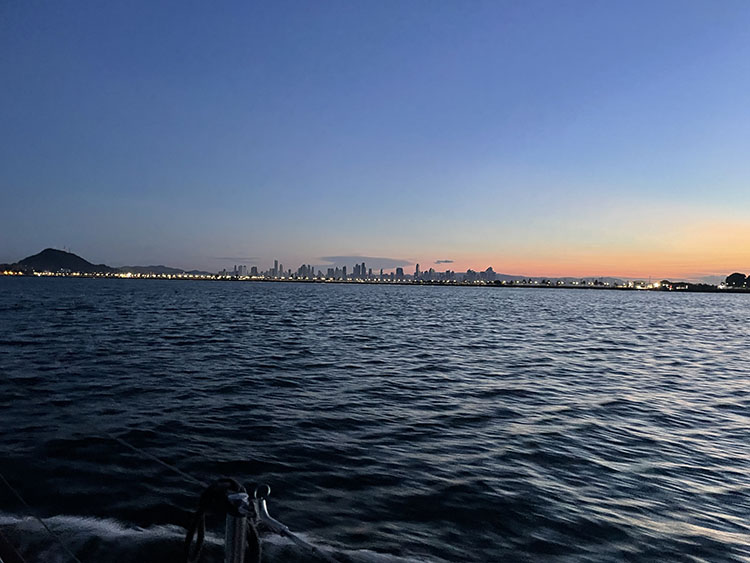
Panama Canal Transit – September 10, 2022

We arrived at La Playita Marina on September 5, 2022, around 12:30 pm in preparation for our canal transit. The following morning at 8:30 am the canal admeasure agent came and measured the boat for transit. This took no longer than 30 minutes and included me answering a few questions regarding the boat. He left us with some paperwork and a canal transit number on a piece of cardboard.

Instead of doing all the legwork ourselves, we opted to use a canal agent, Erick Galvez, to help coordinate the canal transit. Because we were Panama Posse members, we received a discount on his fee. We had heard it could be done without the expense of an agent, but the process can be time-consuming and a bit hectic to get everything done properly. We opted for the K.I.S.S. approach and kept it simple. Erick made the process very easy, as he handled everything, including bringing four 125´ lines and 8 real fenders, not tires, to the boat one morning. He accepted a credit card for a small fee. The total cost to transit the canal was slightly less than $3,000.00. This included 4 line handlers, admeasure, permits, canal advisor, 4 lines, and 8 fenders. I did nothing but steer the boat and Lynette fixed meals. We had to prepare meals for everyone along with drinks. Lynette prepared a very nice scrambled egg and bacon breakfast burrito and a pasta dish for lunch. These meals were excellent and satisfied everyone.

La Playita Marina is known for its heavy surge at the docks. The night before our transit we had the worst surge we had ever had at a dock. We were down below sleeping when all of a sudden we heard a big bang, almost like a gunshot right next to the boat. I went topside to see what it was and found that the port mid-cleat line chock had been ripped off the toe rail. It had been through-bolted with backing washers and the two bolts had sheered right off from the stress of the surge on our spring lines. Sigh, another project to put on the never-ending to-do lists.

Panama City skyline at sunrise

Our transit was scheduled for 7:15 am on Saturday, September 10, 2022. Erick told us that 4 line handlers would be at our boat at 4:00 am, and we were to be at buoy 6 by 5:00 am to meet our canal advisor. The canal advisor is in charge of the transit process and is in communication with the canal traffic control people during the transit.

Setting moon, waiting for the canal advisor

Once we picked up the canal agent, we were on our way to the first lock in the canal. The plan was to raft up with our buddy boat, New Horizons, and enter the canal together. This happened without incident, although we had to wait a bit for the other boats that were entering the lock to get into position before we could enter the lock, as we were to be last in.

Rafting up with New Horizons

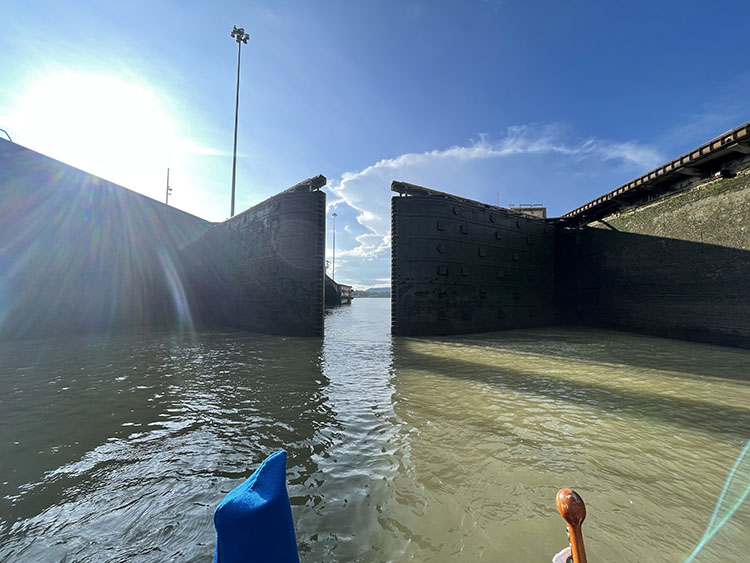
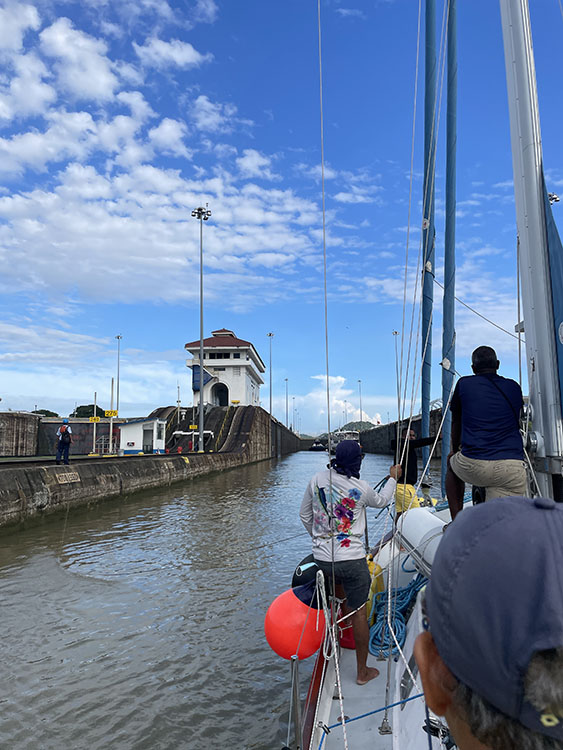
It was entertaining to watch the line handlers dance around the two boats as they caught monkey fists thrown for the lock sides and attached the large lines that would secure our boats in the lock. Once secured the huge lock gates closed slowly and the lock began to fill with water.

We had heard horror stories of big turbulences that would bounce the boat around, but we experienced almost none of that. Yes, there were turbulences, but nothing that disturbed the boats much. All-in-all, transiting the locks was uneventful and almost boring after experiencing the first lock.

Mira Flores gates closing

We stayed rafted with New Horizons through all three of the Pacific locks; the two Miraflores locks and the Pedro Miguel lock. Once out of these locks we unrafted and started our trek through Lake Gatún. This reminded me of motoring up and down the Columbia River. Red buoys on one side and green buoys on the other that marked the channel, along with big ships coming and going. Outside the channel it was very shallow, so we stayed as close to the buoys as we could along our starboard side.

Motoring into second Mira Flores lock

About 2/3 of the way through Lake Gatún it started to rain heavily, and the wind picked up to about 18 knots. Quite a change in a very short period of time. By the time we arrived at the Gatún Locks, it had stopped raining and New Horizons was waiting to raft up to us again for the transit through the last 3 locks. We then had to wait for a large cargo ship that was going to lock down with us. Once all were secured in the first lock, we started the downward process.

Monkey fist tied to lifeline

Within 45 minutes we were out of the last lock and our Panama Canal experience was over. We unrafted from New Horizons and headed to the rendezvous point where our canal advisor disembarked. We were now on our way to Shelter Bay Marina. We hailed the marina on VHF when we got close, and they instructed us how to enter the channel and which dock we were to tie up to. By 5:30 pm we were securely tied up. The long day was finally over. We said our goodbyes to the 4 line handlers and they took the lines and fenders off the boat and headed to their pickup spot at the marina.
Moonrise over Shelter Bay Marina

We were tired and not very interested in fixing dinner, so we took a much-needed shower and walked up to the marina restaurant for a nice, juicy hamburger and a beer. We were finally on the Caribbean side of Panama!

Exploring the Las Perlas Archipelago – Fall 2022

A great sail to Isla Bona

We left Marina Vista Mar at noon on Tuesday, September 30th, after being there for 4 months. This was the longest we’ve stayed anywhere since we left Oregon, except for San Diego. Our first destination was a short 23nm to Isla Bona for an overnight anchorage on our way to the Las Perlas archipelago. It was a beautiful day with 10 knots of wind, so we sailed almost the entire distance under full main and yankee. The wind dropped about 5nm from the anchorage, so we motored the rest of the way in. The wildlife was scarce, except one turtle and a few dolphins were spotted at the end of the passage. We anchored in 40´ of water at 5:10 pm and felt happy we had been able to sail. This was a great short passage ending at a nice, calm, protected bay. We would sleep well that night. Before dark, we were joined by a fishing boat that had dropped its nets in the bay for the night.

Isla Bona anchorage

As luck would have it, we did have some issues along the way. We had left Marina Vista Mar with a full holding tank, planning to dump it when we got offshore. Unfortunately, the holding tank pump wouldn’t empty the tank. I could hear the pump running, but it wasn’t sucking the liquid out. This was a problem; the tank was so full we couldn’t use the toilet. Lynette was not a happy camper as we had to resort to using a Home Depot 5-gal bucket as a toilet until I could figure out why the pump wasn’t doing its job. A messy job, but I tore the pump apart to see if there was any damage to the flapper valves or diaphragm. They looked to be in great condition, and nothing was stuck in the valves. I reassembled the pump and tried it again. No luck. It still wasn’t pumping. I got to thinking about what could have caused the problem and came up with the fact that we had our hull cleaned that morning. I wondered if the diver had dislodged some barnacles that might have gotten stuck in the discharge seacock, causing the pump to not prime. It was a working theory that I would soon test. I gave up for the night and had a great night’s sleep.

Isla Chapera anchorage

The next morning, we weighed anchor at 8:00 am after the fishing boat pulled in all its nets. We hadn’t realized that they had nets all around our boat, so it was good that they started their day before we tried to leave the anchorage. Our next stop was Isla Chapera, one of the northern Las Perlas islands. This is where we would meet up with our canal buddy boat, New Horizons. They left Marina Vista Mar a few days before we left.

We had our first, and only problem of the day when the anchor shackle got stuck in the anchor roller, and the windlass clutch wouldn’t release the chain to lower the anchor. After a bit of pounding on the windlass gypsy with a plastic mallet, I was able to release the clutch so I could lower the anchor a bit to take the twist out of the anchor shackle. Finally, the anchor was up and secured.

The passage to Isla Chapera was 36.5nm and we were sailing on a close reach in 9 knots of wind. This was another great sailing day. The wind lightened a bit, so I deployed the staysail as well. With all the canvas flying, we were able to gain almost another knot of speed. It’s nice to know that our staysail can help in light winds.

The winds lightened, even more, so we furled the sails and began motoring. We were approaching the shipping lanes where the cargo ships travel to and from the Panama Canal, so having the sails down and motoring made it easier for us to maneuver should the need arise. It was now 10:30 am and we saw many cargo ships coming and going. Luckily, they weren’t too close, so we didn’t have to alter course for any of them. As we were crossing the shipping lanes, it started raining, and a huge downpour thoroughly soaked me. Finally clear of the shipping lanes, we saw a couple of dolphins but no whales. Whales had been reported by New Horizons when they passed this way a few days prior, but we saw none. What we did see was a lot of trash floating by. I mean, lots! Mostly plastic bottles and other plastic things. Disgusting!

New Horizons at Isla Chapera

We arrived at our anchorage at 3:45 pm and dropped the hook. Spencer and Dara from New Horizons swam over to chat a bit. I was still struggling with the holding tank issue in my mind, trying to come up with why it wasn’t working. I kept coming back to my theory that the hull cleaning from the other day clogged the discharge seacock, so with that in mind I decided to take the pump apart again and using my air compressor, blew air through the discharge pipe. After a bit, I could hear a whoosh and bubbles coming out from under the boat. I put the pump back together and still nothing. Since it was difficult to get the pump back together where it was located, I figured I had pinched the seal allowing the pump to leak air. I pressurized the holding tank by blowing air through the vent hose forcing the liquid up to the pump. This worked and I was able to finally pump out the holding tank. No more using the bucket! I must say, Lynette was quite pleased with this and no longer chides me for having an air compress on the boat.

San Miguel anchorage

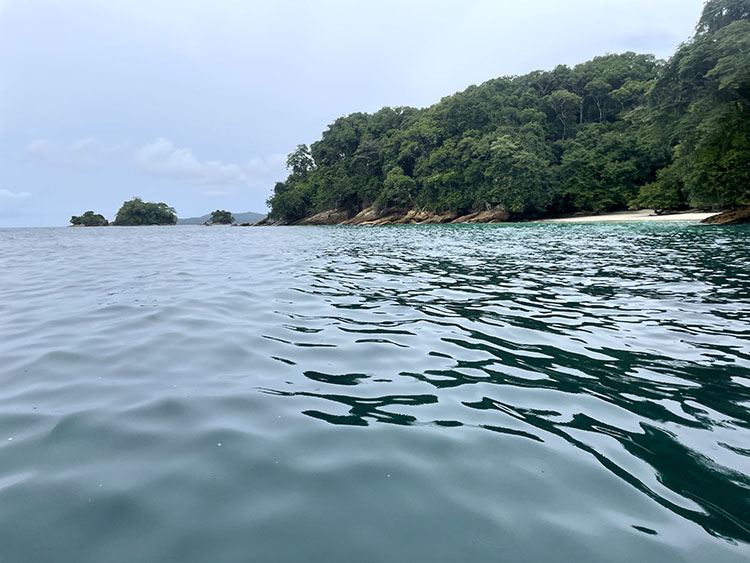
We didn’t leave the anchorage until 11:30 am, as I wanted to get the holding tank pump self-priming issue solved before we left. Success! I used some silicone grease on the seal, and that did the trick. The pump was finally self-priming. With that project behind us, we weighed anchor and headed to our next stop, a bay near San Miguel on Isla Del Rey. We motored the whole 9.6nm and dropped the hook at 1:30 pm. Along the way, we saw a few whales off in the distance. This was a very calm anchorage and I was invited by New Horizons to go for a kayak ride with them. They wanted to do some snorkeling and I stayed on the kayak and followed them. We kayaked over to a beach that was littered with plastic trash. Sad to see. We spent a little time exercising our legs with a short walk. It was nice to get off the boat for a while. Because it was so calm in this anchorage, we stayed two nights. It was nice to just relax and not feel a need to move on so quickly.

Isla Espiritu Santo anchorage
Dinghy ride to go snorkeling

It’s now September 3rd, and time to move to our next anchorage, Isla Espiritu Santo. We weighed anchor at 12:30 pm with no wind. This was a rather quick 8nm motor with several whales being spotted off in the distance. We saw a couple of really good breaches, which were exciting to see. I wish they had been closer so we could have taken pictures, but they were quite far off. We dropped anchor at 2:30 pm in 13´ of water. The next morning, I launched the dinghy and picked up Dara from New Horizons to go snorkeling. Spencer and Colette were in the kayak. Three of us went snorkeling off a small island around the corner from our anchorage while Colette tended to the kayak and dinghy. This was the first time I’d gone snorkeling in many years. It was fun to explore the area and get some needed exercise as well. The water wasn’t too clear, but I could see the bottom and did see some schools of fish. Lynette stayed back on No Regrets, but she did go for a swim around the boat once we got back.

Isla Espiritu Santo was the farthest south we went in the Las Perlas archipelago. It was now time to head toward Panama City and our canal transit. We weighed anchor at just after 1:00 pm on a cloudy September 4th heading for Isla Contadora, an 18nm passage. As we were leaving the anchorage we crossed paths with La Kahina, our dock mates back in Marina Vista Mar. We chatted for a bit on the VHF and bid them farewell. They were heading to the Galapagos and then further west. We enjoyed chatting and catching up on their adventures since we last saw them.

Isla Contadora anchorage

There was a bit of a swell and it started sprinkling. On the plus side, we had 10 knots of wind, so we unfurled all sails and were making 5.5 knots close reaching. We were able to sail for a little over an hour before the wind dropped to 5 knots. I started the engine so we could anchor before dark. We found a nice spot to anchor next to New Horizons and dropped the hook just before 6:00 pm on the north side of Isla Contadora. This is the most populated island of the Las Perlas archipelago. It even has a small airport. New Horizons had arrived a bit before us and anchored unknowingly right in the airport’s flight path. A landing plane caused New Horizons to reconsider their anchoring location, so they moved to this new location before we arrived.

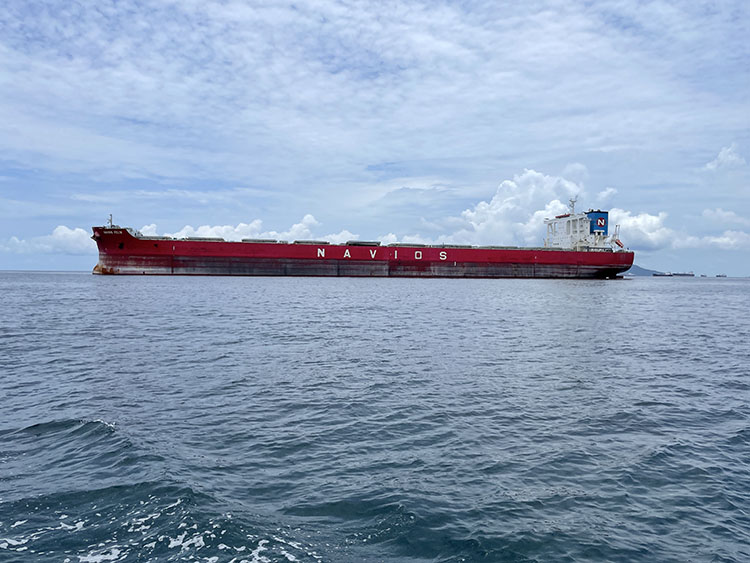
Anchored cargo ship

Monday morning, September 5th, at 7:15 am, we weighed anchor and headed toward our last marina on the Pacific side of Panama, La Playita Marina. This was a 34nm passage and we left early to be sure to arrive before sunset. It was a hazy, partly sunny day with calm winds and water. We motored the whole distance and spotted some whales along the way. They were again pretty far off, so no pictures. As we approached Panama City we saw many large cargo ships anchored and waiting for their canal transit dates. We wove through the anchorage on the way to the marina. When we were close to the marina, we radioed for a slip. This was about 12:30 pm. It took a bit of time to get a slip assigned, so we drifted around inside the marina until they assigned us a slip. We finally tied up at 1:15 pm and shut off the engine. We were off to check in and take showers.

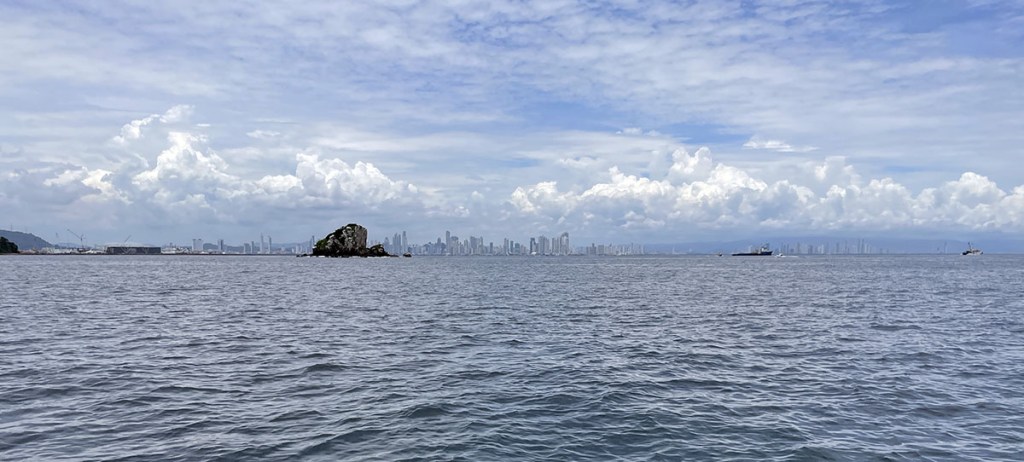
Panama City skyline

Next up, our Panama Canal transit.

Quepos, Costa Rica to San Carlos, Panama – April 2022

Leaving Marina Pez Vela

We motored out of Marina Pez Vela at 5:00 pm for Bahia Drake on April 14th. This was an overnight passage where we motored the entire distance as the winds were less than 5 knots. It was nice to have a clean bottom, as we were going 5.4 knots at 1800 rpm with a slight current against us. We did encounter some lightning and rain along the way and tried to dodge as much of it as we could using the radar to find the best path. We were semi-successful at dodging most of the rain, but lightning always scares me on a boat, so we packed up all the portable electronics and put them in the oven. I’m not sure that would help, but it made sense at the time. Luckily, we didn’t get hit (knock on wood) this time.

We passed all the weather by midnight but had to slow ourselves down a bit to arrive at Bahia Drake in the daylight. We were going 5.1 knots at 1500 rpm now, still motoring in light winds. We made it to the anchorage around 5:45 am, just as it was getting light enough to see the other boats in the anchorage. We had no problems anchoring and immediately went to bed for some much-needed sleep.

Rainbow at Bahia Drake

We spent the next two days in the bay and on the boat the whole time. I wished we had the courage and strength to do more beach landings, but after the near swamping at Playa Hermosa, we realized without wheels on the dinghy, we were doomed to be stuck on the boat while at anchor. Plus, it is quite an effort to launch the dinghy and attach the outboard, then reverse the process when we were done. Even though we were stuck on the boat, it was a nice and quiet anchorage, and a couple of days’ rest was very nice.

We weighed anchor on the afternoon of April 17th and headed to Banana Bay Marina in the small town of Golfito, Costa Rica. This is the last port in Costa Rica and where we checked out of the country to head for Panama. We left in the rain with about 8 knots of wind on the nose, so we were motoring yet again. The seas were lumpy, and winds increased to 20 knots on the nose once we rounded the point. We were making about 4 knots with the engine at 1900 rpm. We weren’t expecting the increase in wind as all the weather models in PredictWind reported much lighter winds. This isn’t the first time PredictWind gave us an inaccurate weather report. We’ve learned to use PredictWind as a good guide, but not necessarily something we can count on for absolute accuracy. The winds did subside in the early morning hours after we were knocked around for many hours and were seasick the entire passage.

Golfito at dawn

It was a welcome reprieve from the rough seas once in the gulf heading toward Golfito. We arrived at Banana Bay Marina on the morning of April 18th at 7:30 am. When we radioed the marina, they said a boat was still in our slip. We had to wait about 30 minutes before we could dock. We decided to anchor out in front of the marina with about half a dozen other boats.

Unfortunately, during the rough weather our anchor chain had tangled in the chain locker so we could only get about 25´ of chain out. On top of that, the windlass stopped working. Issues always happen in multiples. We were able to get the anchor back up but were now stuck in a slight current with other boats anchored close by. Our only option was to motor back and forth in front of the marina waiting for our slip. After about 30 minutes of this back and forth a catamaran owner asked if we wanted to tie up to his stern. We gladly accepted the offer and finally could stop motoring back and forth. The marina called about 15 minutes later and said the slip was ready, so we untied from the catamaran and motored to the slip.

We were finally in the slip a little after 8 am, and dead tired. Neither of us had gotten much sleep during the rough seas the previous night, and we wanted to get some much-needed sleep. That was not to happen as the galley was a mess from the passage. Things on the counter that had never moved on all our passages, had been thrown all over the place. Our eggs all broke on the counter making a huge mess that dripped down into the freezer and refrigerator.

Lynette went to work cleaning up the mess while I took all the tools and supplies out of the V-berth to get to the chain locker. I was able to get the chain untangled and dropped all 400´ into the water to be sure there were no other knots in the chain. I then started troubleshooting why the windlass wouldn’t work. I disconnected the solenoid and foot switch and tested each. The solenoid passed, but the switch didn’t. I took the switch up to the marina office and they said they would find one for me. Two days later they had an exact replacement for the switch. I was amazed one was available in such a backwater place as Golfito. Meanwhile, the chain was still in the water, so I quickly connected the switch and ran the chain back into the locker. Project completed. Cost? About $35 for the switch.

Next, I had to disassemble the Racor turbine filter as the water alarm for the filter had gone off during this passage. That was a messy job as I had to contain all the diesel fuel that was in the filter housing. I sucked it out with a small hand pump into a yogurt container and proceeded to disassemble the filter housing. It was full of gunk that had been in the fuel tank and had clogged the fuel filter. It took some time, but I got all the gunk out including all that was in the plastic bowl at the bottom of the filter. Upon reassembly and testing the alarm was still sounding, so I assumed that after enough fuel had run through the filter the alarm would clear itself. Luckily, I was right, because after we left Banana Bay Marina and had motored for a bit the alarm stopped sounding.

Golfito is a very small town that is the southern port of entry in Costa Rica. It doesn’t have much to offer except a rather large duty-free zone at the end of town. The town was once a company town for a big banana export company. It existed for the company workers. After many years the banana company went out of business leaving the town with no place for the people to work. The duty-free zone has brought business to the town and work for its people, but I’m sure many left to look for work elsewhere.

We were able to stock up on some groceries and purchase fuel at the dock. The restaurant at the marina was convenient and served reasonable food. What we noticed about Golfito is that even though the people were friendly and very helpful, the vibe wasn’t the same as up north where there is a heavy tourist focus. No one ever said “Pura Vida” to us in Golfito, whereas up north almost everyone said it. Prices were also much more reasonable in Golfito than up north, where they were inflated to take advantage of the tourist traffic.

Leaving Golfito

We left Banana Bay Marina on April 23rd, at 6 am, after being there for 5 days. Our next port of call was Boca Chica, where we would check into Panama. We had decided, after the rough passage to Golfito to not do any more night passages, so we broke up this passage with two stops along the way, both daytime passages of less than 60nm.

Red roof at Punta Balsa anchorage

Our first stop was Punto Balsa, about 54nm. We arrived around 5 pm. The cruising guides said to anchor near the house with the red roof. We did just that. This was our first anchorage in Panama The time change from Costa Rica to Panama screwed up our timing, but we were still able to anchor before dark. The passage was about as uneventful as it could be. Light wind for most of the passage, so we motor sailed most of the way. The wind finally picked up when we rounded the point, but we were so close to our anchorage, that we dropped the sails and just motored in. It took a couple of tries to anchor, but we finally got it to hold.

Dolphins!

The next day, Sunday, April 24th, we left at 8:45 am and headed to Isla Parida about 35nm away. We were motoring with the breeze on our nose as usual. This was a very calm passage. We saw a few dolphins and turtles along the way that kept our eyes on the water looking for more sea life. We anchored in about 12´ of water at 3 pm. We wove between numerous small islands to arrive at this very protected and secluded anchorage. It was a very pretty place to anchor.

Isla Parida anchorage

We weighed anchor the following day around 8:20 am and headed for Boca Chica, a short 14nm passage. Boca Chica is an out-of-the-way stop, but the only northern port of entry to Panama. The passage weaves between small islands and reefs that we had marked on our chart plotter. There isn’t much to the town and very little to do in Boca Chica.

Reef at low tide, Boca Chica anchorage

We anchored around 11 am in 33´ of water. After we had settled in, we launched the dinghy to travel the 1.5 miles to check in. We couldn’t get any closer to the dock as there is a power line that goes over the water that is too low for our mast to fit under. We checked in using an agent named Carlos for a fee of $90. We contacted him via WhatsApp ahead of time and arranged all the paperwork electronically. It was a short dinghy ride to his dock. Since the paperwork was already done, it was simple and took less than 2 hours (we had to wait for a couple of the officials to arrive at his house).

The next day Carlos’ son-in-law took us to David, the closest city to provision so we could buy Panamanian SIMM cards for our phones. We had decided not to get new SIMM cards until we reached Panama since we were going to be in Panama for about 6 months for hurricane season, thanks to our boat insurance policy. We also purchased a small bullet blender as we had gotten hooked on fruit smoothies while we were in Costa Rica and wanted to make our own onboard.

Since we had decided to do only day passages, we broke up the trip from Boca Chica to Marina Vista Mar into 5 stops. We planned to stay there for several months before making the transit through the canal. We were also watching the weather quite intently as the passage around Punto Mala has a history of being rough. There were reports from other Panama Posse cruisers about how bad Punto Mala was for them, so we weren’t looking forward to that part of the voyage.

Isla Parida

We weighed anchor and left Boca Chica for Isla Secos on April 24th, at 10:15 am, a 19.5nm passage. We followed our incoming tracks as we left. Once out of the small islands and reefs we turned left toward Isla Secos, a small archipelago of 4 islands. We decided on an anchorage at Isla Pargo that wasn’t very well protected but made for easy anchoring. There was a single panga in the anchorage until sunset. We were all alone after they left. The anchorage was a bit rollie, so our sleep wasn’t as nice as we would have liked.

Bahia Honda anchorage

We departed Isla Pargo for Bahia Honda at 7:40 am on Friday, April 29th. Bahia Honda is a nice, protected bay with many favorable comments in the cruising guides. This was a 36nm passage. We opted to anchor near the home of Domingo, called Domingo’s Anchorage. He is a very friendly older man, who comes to your boat on a panga to trade fruits and vegetables for things he needs. No money, please. He doesn’t speak English but does a very good job of communicating. We traded toothbrushes, batteries, olive oil, and cookies for pineapples, mangos, papayas, and bananas. He also offered eggs and chicken, but we declined as we didn’t need either. I think he got the better end of the deal, but it was nice to work through the communication process with him.

He had his grandson (our assumption) driving the panga and he didn’t say a word until we had difficulty understanding that he wanted cooking oil. Seeing that we were struggling to understand Domingo, his grandson said two words, “Cooking oil”. We all laughed as we had no idea he could speak English. He had just let us all struggle with trying to communicate up until that point. Domingo was very excited about the cookies. It was just luck that we had some to give him. He had also wanted fishing line and hooks, but we had neither. This is what cruising is all about. We thoroughly enjoyed the encounter with Domingo and his grandson.

Leaving Bahia Honda

The anchorage was extremely calm. We were able to get an excellent night’s sleep, as we were needing to leave early the next morning. We weighed anchor at 5:45 am on Saturday, April 30th, and headed toward Bahia Arenas, 50nm away. We left on a falling tide and were able to do a bit over 5 knots at 1700rpm. Once outside the bay winds were light so we mostly motor-sailed the entire passage. We attempted to sail once, but with so little wind we decided to start the engine again and motor sail again. We were doing 5.5 knots at 1600rpm, so I wasn’t going to complain.

The wind picked up to about 8.5 knots on the starboard beam, so we killed the engine and were able to sail for about an hour. I’ll take sailing any day over listening to the noise of the engine. This passage was a great example of our sailing experience on the west coast of the Americas; sail a little, motor a lot.

Anchorage at Bahia Arenas

We anchored at Bahia Arenas at 3:45 pm on April 29th in 20´ of water. It was a calm anchorage with only a slight roll. We saw this anchorage as a way to break up the passage from Bahia Honda to Punta Guanico into two daytime passages as opposed to an overnight passage. We were able to relax, eat, and get a good night’s sleep.

We left Bahia Arenas at 5:45 am on April 30th with PredictWind indicating a possible bumpy ride to Punta Guanico. Our autopilot decided to stop working so while motoring we had to hand steer. The wind picked up, so we killed the engine and engaged the Hydrovane to take over steering, a nice break for us.

AIS is such a great bit of technology. We were able to identify a sailing vessel coming toward us as Easy Breezy, so hailed them on VHF. They were heading north, and we were heading south, so we had a nice chat about the weather and places to stop along the way.

Punto Guanico

The wind picked up and it looked like it was going to blow even harder, so we furled the sails and went back to motoring. Shortly after that, we encountered 25+ knot winds with very bumpy seas. We were glad we had furled the sails. We rounded the point and started looking for a spot to anchor that was reasonably protected from the wind. We wound up tucking in as close to shore as we could get and set the hook in 20´ of water at about 3:10 pm. It wasn’t the best protection and we thought we’d be in for a rough night, but shortly after anchoring the winds died and the sea calmed down. Another sailboat came in a bit later and anchored behind us. Oddly, we were hailed on our VHF by someone on shore. He was from the US and was curious about who we were. We talked for a bit. He had a tourist fishing business and was in Panama for half the year and then back in the US the other half. It was fun to share our situations and nice to have someone new to talk with.

Next stop, Isla Iguana. We weighed anchor and left Punta Guanico at 5:45 am on May 2nd. Although Isla Iguana was only 33nm away, we decided to give ourselves plenty of time, as we didn’t know what Punto Mala had in store for us. We could have heavy winds, strong opposing current, or both. As we approached Punto Mala we kept close to shore to avoid any strong current, and kept the sails furled, choosing to motor just in case. We were lucky. There were no strong winds or current. It was a very easy passage and we arrived at Isla Iguana in time for lunch at 12:30 pm.

The cruising guides indicated that Isla Iguana was a day anchorage with a reef between the anchorage and the beach. Plus, the anchorage was 50´ deep. I reached out to a cruiser who had overnighted there to get first-hand information on spending the night. He indicated that it was ok if you could get the anchor to hold. We attempted to anchor but never got the anchor to hold, so decided this would be a lunch break for us. I didn’t want to risk an overnight stop with the anchor not holding well, so we would continue to Marina Vista Mar that evening. Yes, we broke our rule and decided our only option was to do an overnight passage. Having decided that, we took a nap to be well-rested for the overnight passage.

The beach at Isla Iguana was very pretty. It was also very crowded with many small boats anchored inside the reef, and many people playing on the beach and swimming. We were surprised by how noisy it was with boats coming and going and kids making noise at the beach. By 3:00 pm they were all gone leaving us alone anchored outside the reef. Quite a sharp contrast to the noise of earlier. The only noises now were the birds. Isla Iguana is a wildlife refuge, and there were many birds on the island and in the air.

Marina Vista Mar

We left Isla Iguana at 5:30 pm with plenty of time to arrive at Marina Vista Mar during daylight. This was a 52.4nm passage and we planned for an early morning arrival at the marina. With the autopilot still broken we hand-steered while motoring. This gave Lynette a chance to practice steering to a compass heading. It was good practice and she did great! It seemed strange to see the sunset on the port side of the boat. We had always watched it set on the starboard side, but since Panama lies east and west we were heading almost due north. This is our first time traveling north since we left Oregon.

No Regrets at Marina Vista Mar

I made coffee to stay awake and we both enjoyed talking about events in our pasts. We motored until 10:30 pm when the wind decided to cooperate. This gave us a break from hand steering as we could use the Hydrovane wind vane to steer. We were close reaching on a port tack at 3.8 knots in 9 knots of wind. A nice, quiet, and easy sail. The wind died down to 5.5 knots. We were now sailing at less than 3 knots. Normally I would start the engine and motor sail to keep the speed up, but we needed to keep a slow pace to arrive at the marina after daybreak. We alternated between motor sailing and sailing as the wind varied. We arrived at the Marina Vista Mar fuel dock at 7:00 am on April 3rd. We topped off our fuel tank and took a slip. We had arrived, safe and sound.

Chiapas, Mexico to Quepos, Costa Rica – Spring 2022

It is now Monday the 28th of February, and we’d been in Chiapas long enough. El Salvador was beckoning us. Checking out of Mexico was handled through Memo, the harbormaster, for a reasonable fee. He took a group of us around to the various offices and handled the entire process for us. Even so, it took about 3 hours to complete the checkout. The final step was to have the military clear us out. Once the military had finished with their paperwork, we were instructed to leave immediately while they watched us leave.

As it worked out, we were the last of three boats to leave that day, which put us about 2 hours behind our scheduled departure. We had wanted to leave around 1:30 pm but didn’t leave until about 2:45 pm. I know, cruisers shouldn’t have schedules, but we had a day and time we were to meet the bar pilot outside the El Salvador bar, so the schedule was important for this passage.

This was our first time outside Mexico since mid-November of 2021. Friends told us we would be leaving excellent dining behind. According to many cruisers, Mexico has the best food in all of Latin America. Food, both in restaurants and grocery stores, had been very inexpensive in Mexico. Not so, as we moved further south.

Next stop, Bahia del Sol, El Salvador. This was a 2-day passage of about 238nm. It was quite a rough start leaving the bay. We were pinching tight to the wind with a choppy sea, and motor sailing to try and catch up to our buddy boat, Lola. They were another Panama Posse couple we met in Chiapas on a catamaran. Their catamaran was a bit faster than our boat, so they stayed ahead of us the entire passage. We didn’t catch up to them until we got to the meeting point outside the bar.

Sunrise coming into El Salvador

When we are on a passage, we normally don’t fix food. We snack and eat things we prepare a day or so before the passage. That first evening we ate carrots and celery with the hummus I had made the day before. I commented in the log that the hummus had just a bit too much lemon, but it was really good.

The first night we rolled a lot, so neither of us got any sleep. The next day was not much better, but we both catnapped throughout the day, motor sailing with just the mainsail. The seas calmed down sometime during the next day and stayed that way for the rest of the passage. We did motor sail most of the way to keep our speed up, as we had that schedule to meet the bar pilot for a high tide crossing of the bar. We were scheduled to cross the bar at approximately 2:55 pm on Wednesday the 2nd of March. This bar crossing is somewhat dangerous, so you must hire a bar pilot to guide you across the bar both coming and going. It was $25 each way. Not expensive at all.

The engine stopped around 6 pm that first evening. I thought it was probably a clogged fuel filter as the vacuum gauge on the Racor indicated the filter needed to be changed. The wind was about 10 knots, so we sailed for a while at 4.5 knots. That gave me time to change the filter. I was surprised when I took the filter out as it didn’t look very dirty. I tossed it anyway as I had quite a few spares. I restarted the engine and we continued to motor sail to try and keep pace with Lola.

The engine stopped again a while later and Lynette asked me if our other tank used the same fuel line into the filter. What a great question! I hadn’t thought about the axillary tank, so I switched to that tank, and the engine kept running with no further issues. With Lynette’s brilliant question, we determined we had a fouled main fuel tank, and when the seas were rough it stirred up the gunk in the bottom and starved the engine of fuel. Sometimes it takes another person’s perspective to solve problems.

The axillary tank only holds about 10 gallons of fuel, which wasn’t enough to get us to our destination. After a while, I switched back to the main tank when the seas calmed down and we were able to continue using the main tank. That would change in a few hours, and we were back on the axillary tank. Another item added to our fix list. Note: this issue haunted us for some time until we got to the boatyard in Quepos where they could polish the fuel and clean the tank.

We continued switching back and forth between the main and axillary tanks depending on the sea state. If it calmed down, we would motor using the main tank until the engine quit when it became choppy. Then we’d switch to the axillary tank. We did have to add 5 gallons of fuel to the axillary tank from one of our jerry cans at one point, as we had used up the 10 gallons in that tank.

There wasn’t much in the way of sea life. We did spot some dolphins a couple of times, but that was about it. Marine traffic was sparse as well, except when we passed a commercial port in Guatemala. There were also some fishermen along the way, but we saw no long lines, thankfully.

Crossing the El Salvador Bar

With all the motor sailing, we were able to reach the rendezvous spot for the pilot about an hour early. Lola was already there and had been waiting about an hour. The pilot, via VHF, said we should anchor NW of the rendezvous spot, so we anchored near the shore with quite a strong onshore breeze. This was not a fun anchorage as waves were crashing right behind us. We felt good that our Spade anchor has always set quickly and held well. After about 30 minutes, the pilot radioed us to move to the rendezvous spot, so we hoisted the anchor and motored for about 30 minutes to the spot where the pilot boat was waiting. Lola went first across the bar with no issues. The pilot then came back for us and off we went. The bar crossing was uneventful. No worse than crossing the Columbia Bar on a good day.

Bahia del Sol Marina

We were met at the dock by line handlers and Bill and Jean, an ex-pat couple who helped the boating community in the area. Jean handed each of us a cold cocktail and took me to check in. Lynette stayed with Bill and a couple from the boat next to us (we had met them in Barra along with their 3 kids). Lynette tried to clean up the boat while I was checking in, but she was just too tired. She waited a while for me, and when I didn’t return, she walked up to the pool. There I was, sitting with Lori and Doug from Lola having a $1 beer. She decided to order a margarita.

The pool at Bahia del Sol

We knew we were no longer in Mexico when we ate dinner at the resort buffet. It was more expensive than dinners in Mexico and definitely in the category of cafeteria food (think cafeteria lunch in grade school). It did fill the void and satisfied our hunger, though.

We had been using Mexican Pesos for so long that we no longer had any US dollars. El Salvador uses the US dollar as its currency, and without any dollars, we were fortunate that everything we bought at the marina was put on our tab. We didn’t need any money while at the marina.

San Salvador, the capital of El Salvador, is a good-sized city inland from the marina and the only place with large grocery stores to provision. There are several small stores closer to the marina, but we wanted to go to a well-stocked store. We rented a car with our boat buddies and took a day trip to San Salvador. None of us had local cell phone SIM cards, so using our phones to navigate was unpredictable and often nonexistent. What a helpless feeling without Waze to guide us. Our first stop was an ATM. I had left my ATM card in a machine in Chiapas, so we had to use Lynette’s ATM card. She hadn’t used it for many years, so had forgotten her PIN. We finally figured it out and were able to withdraw some cash. I was now feeling a bit less stressed over not having cash.

Doug, from Lola, wanted to find a local cellular store so he could buy a phone to use in El Salvador but first, we were all hungry. We found an Olive Garden at one of the malls, so we ate there. It was a little odd to sail all the way to El Salvador and eat at an Olive Garden, but it was good and satisfied everyone’s hunger. Back to the cell phone issue. Doug found a cell phone store near the restaurant and purchased a local phone. He was finally able to use Waze reliably so we could explore the city and find our way back to the marina. Lynette and I had decided not to purchase SIMs until we got to Panama, as we weren’t going to spend much time in any country before Panama.

We heard from others at the marina that the best grocery store was across the street from the US Embassy, so with Waze guiding us, we found the store. I must say, this store was very well stocked and because of its location across the street from the US Embassy, had many items you would see in US stores. Groceries were noticeably more expensive than in Mexico, but not as expensive as in the US. Speaking of the US Embassy, it is a very large and nice-looking complex of many buildings with very well-manicured landscaping.

On Saturday we went to a gathering at Bill and Jean’s home, with other Panama Posse members, for cocktails and a traditional El Salvadorian food called Pulpusas (stuffed tortillas). This is a weekly event they put on for visiting cruisers when they are available. They sent a panga to pick us up and take us back to our boat, as we didn’t want to launch our dinghy for just one event. We had an enjoyable evening with great food and conversations.

Leaving El Salvador and crossing the bar

We stayed at the marina in El Salvador until Wednesday, March 9th, and left with Lola and Brisa heading south at 6:30 am. Lola being one of them. The bar crossing went smoothly with no issues for any of us crossing that morning. I could see storm clouds on the horizon, so I used the radar to seek a path with the least amount of rain. We still got a drenching, which gave us time to clean the cockpit.

Because of rough seas and then calm repeating almost the entire trip to Costa Rica, we had to keep switching from the main tank to the axillary tank. We were able to do some sailing. There were some periods of strong winds up to 30 knots on the nose, where we furled the sails, but otherwise mostly motor sailing.

I was worried that we were spending too much time on the 10-gallon axillary tank and that we would eventually run out of fuel. We had 15 gallons of fuel in jerry cans and by the time we got to our anchorage in Costa Rica, we had put all of that in the axillary tank. Every chance I got, I switched back to the main tank for as long as it would keep the engine running, but the engine was continuing to run less and less using the main tank.

Sea life was reasonably abundant. Some turtles and quite a few dolphins passed by. We were usually in the presence of some fishermen with their long lines stretched across our path. We never encountered any but thought we saw some close one night, as there were lights on the water that might have been long-line float lights.

The seas never really calmed down, so we were both a bit seasick. I decided to move closer to shore to see if the seas were a bit calmer and the wind a bit less. We were in luck as we found a smoother patch of water with a bit less wind. Because of our slow headway, often under 3 knots due to the current, we were not going to make it to Marina Papagayo on Friday before dark. I started looking for a good anchorage to overnight, so we could arrive at the marina in the daylight the following day.

Our anchorage at Playa Nacascolo

I picked what looked to be an easy anchorage very close to the marina, Playa Nacascolo. We arrived at the anchorage around midnight on our third day out. We slowly motored toward shore until we got to about 20’ and dropped the anchor. We were all alone and only about an hour from the marina. We were dead tired. The anchorage was calm, which allowed us to get a good night’s sleep. It was very quiet in the morning as the sun rose until 10 wave runners came roaring by at full speed. A little while later a catamaran arrived and anchored close by. We ate breakfast and leisurely set out for Marina Papagayo around 11 am on Saturday, the 12th of March. We got there in an hour and were tied up within minutes.

Because of COVID, Costa Rica required arriving and leaving boaters to use an agent to check in and check out (this has now changed, and an agent is no longer required). The check-in cost was $450 and the check-out was $200. Quite expensive, and to top it off we were charged an extra $100 for overtime to check in on Saturday. In the many text conversations we had with the agent, he did not mention an overtime fee. If he had told us there would be an overtime fee of $100, we would have stayed on the anchor until Monday and gone to the marina then. We weren’t told, so we suffered the consequences, and he picked up an easy $100.

Marina Papagayo, Costa Rica

Marina Papagayo is probably the nicest marina south of San Diego. Everything was in top shape. Excellent pool, showers, and laundry. There was even a very nice restaurant/bar right there. On the downside, the marina was extremely expensive, and it was a $50 taxi ride each way to the nearest grocery store in Playas del Coco. We weren’t in Mexico anymore!

We had dinner that night at the restaurant and the bill came to almost $100! We only had a drink each, two salads, and we split 3 tacos. That was the most expensive meal we had since leaving San Diego by at least double, if not more. Oh well, at least the food was very good.

The next day we discovered we had indeed gotten tangled up in some long lines along the way, but never knew it. We were dragging about 100´ of line behind us. The prop and shaft were heavily tangled with line. Doug, from Lola, came over and we both spent over 2 hours with knives cutting the tangled mess from the prop and shaft. When we were done, the dock was littered with line, swivels, and hooks. What a mess. We also discovered that the Spurs line cutter stationary cutter was missing, so somehow it got broken off.

Curious iguana at Marina Papagayo

Sunday night there was a Panama Posse potluck as there were quite a few Panama Posse boats at the marina, including the leader and founder of the Panama Posse, Dietmar. We had a wonderful time with lots to eat and many great conversations. It seems that most Sundays the group of Panama Posse cruisers in the marina do something together. The following Sunday was pizza night. Again, another great night of conversations, pizza, and beer.

We stayed longer than we wanted to at Marina Papagayo waiting for a package to arrive. It kept getting delayed in Costa Rican Customs and the shipping company kept asking for more paperwork from us. The package was supposed to be arriving at a friend’s house in Playas del Coco, with the plan that he was to deliver it to us at the marina. With the cost of staying at the marina adding up and still no package, we decide to move to an anchorage near Playas del Coco, Playa Hermosa. The new plan was to have our friend drive the package to Playa Hermosa instead of Marina Papagayo.

Sunset at Playa Hermosa

We stayed at Playa Hermosa on the hook for about a week waiting for the package. It never arrived. This beach has a shore break that made it difficult to land our dinghy ashore, so we made a test run with our dinghy to shore. If it hadn’t been for some nice people on the beach helping us land the dinghy, we would have swamped the dinghy. We thanked them and took a much-needed walk along the beach. It was nice to be off the boat and on land for a change, getting some exercise. We also had help getting the dinghy back in the water. Lesson learned; without dinghy wheels, we could not go to shore while at anchor.

After the umpteenth time, the shipping company asked for more paperwork, we finally found someone at the company who could help us with options. The shipping company had an office at our next port of call, Quepos, and we were able to change the ship-to address from our friend’s house to the shipper’s office in Quepos. We were now free to finally move on and not worry about missing our package.

We weighed anchor on March 29th, 2022, in the evening and motored out of Playa Hermosa to Bahia Samara, about 62nm further south. The passage was a mixed bag of motor sailing and sailing on a close reach while fighting a 1.5-knot current much of the way. When our speed dropped to 3 knots, we would fire up the engine. When we could maintain over 3 knots, we cut the engine.

On this passage, we saw some fish doing flips out of the water. We were never able to catch them on camera, so only have the story to tell. We have no idea what kind of fish they were and why they were doing flips out of the water. Some were jumping quite high, 6 to 8 feet out of the water.

We encountered a float off our port side, and we assumed it was part of a long line so took some evasive action to avoid it. It eventually fell off to our stern and disappeared in the night. Hopefully, we hadn’t snagged a line.

Bahia Samara anchorage

We arrived at Bahia Samara in the early morning after a 12-hour passage and dropped the hook. We were tired so slept much of the day. There was some activity on the beach and fishing boats tied up to mooring balls in the bay. Some of the boats were coming and going all day long. We had read that there were a few good restaurants on the beach, but we didn’t want to chance the surf with the dinghy. We left around 8 am the next day in very calm conditions, heading for Marina Pez Vela in Quepos, Costa Rica. This was a 95nm passage, which took about 24 hours.

Bourbon with a big cube, Bahia Samara

We had some decent sailing and motor sailing. It rained a bit and we saw our first cargo ship in a very long time. The ship crossed our bow and anchored ahead of us. I assume it was waiting for its turn to go into a nearby port. Our closest point of approach after they had anchored was about 1/4nm. The ship was big and brightly lit up. We also saw some fishermen with long lines off in the distance. Their floats were lit, so it was easy to see where they were. We had read there were fish pens in the area, so these lights could have been the fish pens.

Marina Pez Vela, Costa Rica

We arrived at Marina Pez Vela before they were open, so we just drifted outside the marina until someone answered our hail. We docked around 6:30 on April 1st, 2022. Check-in was quick and easy. The marina is very nice with restaurants and a small store nearby.

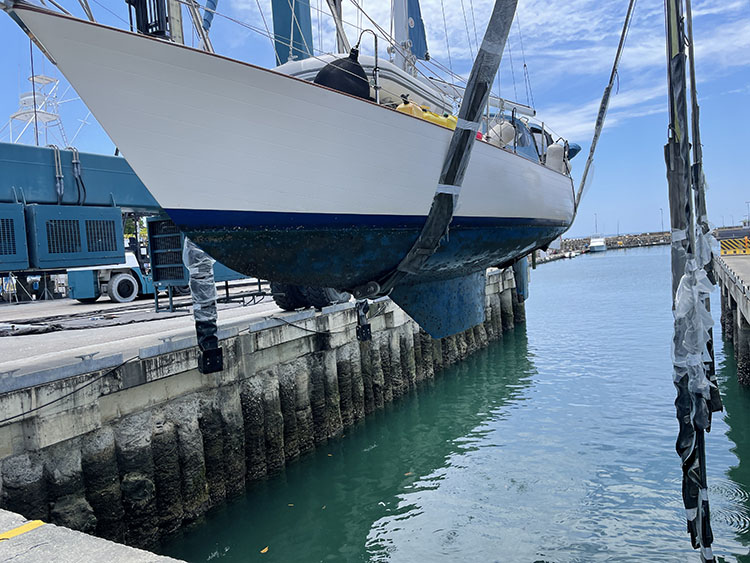
Haul out at Marina Pez Vela

We hauled out the next morning and rented a car along with an Airbnb for the next 10 days. Best 10 days we’ve had since leaving Mexico. We hiked at Manuel Antonio Nature Reserve, ate several dinners at an excellent nearby restaurant, Restaurante El Arado, and swam in the pool at the Airbnb. The Airbnb even had a washer and dryer and air conditioning! It was nice to be off the boat for a while.

During our haul out we had hull damage repaired, the bottom painted, a new depth transducer installed, some voids in the Gelcoat topsides patched, and the fuel polished. They did an excellent job for a fair price that was below their quote. I would highly recommend the Marina Pez Vela Boatyard to anyone needing repairs while traveling in the region.

Leaving Marina Pez Vela

It was now April 13th, 2022, and we splashed with no issues. That evening we went out for drinks with a Panama Posse couple we had met up with several times in the past, Last Arrow. They had been getting free yellowfin tuna from a fishing boat they were docked next to. They came over after dinner and gave us about 10 pounds of fresh sashimi-grade tuna. Wow! We were in heaven. I immediately cut it into meal-sized pieces and froze the lot for future dinners.

The next afternoon we fueled up and motored out with Bahia Drake as our destination.

San Diego to Chiapas, Mexico – Winter 2021-2022

We cut the lines on November 18, 2021, around 4 pm from Chula Vista on our way to Ensenada, just a month and a half late. We were finally on our way! We pulled into Cruiseport Village Marina in Ensenada at around 8 am the following day and were not allowed off the boat until the medical person checked our oxygen levels and temperature. We had to show her our vaccination cards as well. We next paid a visit to the harbormaster office to check into the marina and country. One of the people at the office drove us to immigration, the Port Captain, and the other places where we needed to fill out paperwork and pay the fees to enter Mexican waters. It was nice that all these places were in one building, making it very easy to get everything done promptly. All in all, it took only a couple of hours. We went back to the boat and slept until the next morning. We were quite tired after the all-nighter.

No Regrets in Ensenada

The next morning, we departed Ensenada with a mission to be in Barra de Navidad by December 3rd for the Panama Posse launch party. We were on a fast track. We got fuel at Marina Coral and then motored in circles in the bay to reset our autopilot calibration as it seemed to not be tracking correctly. Off to a great morning start. Our destination was Turtle Bay for an overnight rest. 

Flying the spinnaker

We sailed for two days to arrive at Turtle Bay on the evening of November 22nd. This was a great passage, as we had enough wind to sail instead of just motor. We set the spinnaker for the first time on the second day. What a great day of sailing! We arrived at Turtle Bay and spent the afternoon refueling. There is a Panga that comes to your boat to fill your tanks for a price. It is well known that the fuel prices at Turtle Bay are a rip-off, so I haggled with them to get the price down a bit and was slightly successful. After our tank was full, we rested for the remainder of the day. 

We then motored (mostly) on for another two nights and stopped at Bahia Santa Maria, a nice big bay. We spent that day just hanging out on the boat, resting. It was Thanksgiving and we didn’t have a turkey, so we improvised and had turkey sandwiches as we had some turkey lunch meat. Not fancy, but we gave thanks regardless. The next day we left in the late afternoon, on the 26th of November. We had a slightly eventful sail/motor to San Jose del Cabo. There was a boat a bit too close on our tail. It was a bit unnerving to have them so close, so we hailed them to back off nicely. It is a big ocean, no need to be so close to another boat.

Out of nowhere, the winds picked up on the second night out. We had not been prepared for this as none of PredictWind’s weather models had predicted wind. I had set up for a nice night passage and got knocked around quite a bit as I wasn’t prepared for the wind and rough seas. It was about this time that we ran out of fuel in our main tank, so switched to the secondary tank to finish the passage to our San Jose del Cabo. A nice feature of our new Beta Marine engine is that it auto-primes the fuel, so we didn’t have to bleed the fuel lines after we ran out of fuel and sucked air. 

We arrived at San Jose del Cabo on the 28th of November. The marina was nice but only the fuel dock was open, so we filled up and went to our slip. We are required to check in with the Harbor Master and the Port Captain, but it was a Saturday, and they were both closed, so we had to go without a check-in. At the shower building, there was a self-pay station where we used our credit card to pay for the slip. Kind of convenient. We took showers and went for lunch with my sister, who lives part-time in the area. She took us to provision at La Comer after our wonderful lunch. What a nice big grocery store. They had lots of food choices, so we stocked up quite well. 

The next morning, we left for Puerto Vallarta. The winds were favorable, so we sailed on a beam reach for a bit over 24 hours. It is so nice to turn the engine off and the only thing you hear is the creak of the boat and the ocean-going by. As with all things, the wind left us and we had to motor for the last few hours. When we arrived at Marina Vallarta we went to check in, get a shower and have dinner ashore. After a 3-day passage we were dead tired, so went to bed early for a good night’s sleep. 

Panama Posse Party, December 2021 at Barra de Navidad, Mexico

It is now the 1st of December, and we have a two-day passage ahead to reach our destination of Barra de Navidad. The Panama Posse event started on the evening of the 2nd, so we were going to miss the meet and greet scheduled for that evening. We did make it in time for the party on the 3rd. There were seminars on navigation, provisioning, etc., and a big potluck on the 4th. After the 4th many Posse members left for parts unknown, we stayed a month as we still had projects to complete. 

I finished installing the watermaker and commissioning it (finally). We couldn’t test it in the marina, so we took the boat out in the ocean to test it and then dump our holding tank. In that order, of course. We found out later that since there are not many dumping stations in Mexico the Marinas are not safe to swim in if you get my drift. At high tide, many just dump their tanks in the marina. Luckily there was a nice pool at the resort we could swim in. 

Resort pool

On our way out to make water and dump our tanks, we had a mishap. I hit an immovable object. We had a big gash in the side of our boat. We had just gotten the bottom cleaned by a crew that works at the marina, and the crew put a temporary patch on the damaged area to keep the water out until we get to a boat yard to haul it out and fix it properly (Costa Rica possibly).

Barra de Navidad Marina

The Barra marina is very nice. The showers were good when there was hot water, and the laundry service (no one does their own laundry) was great and inexpensive. The best was the French baker who came to the marina in his boat ringing his bell to announce his arrival. He would come right to your dock with pastries, bread, and other tasty items. 

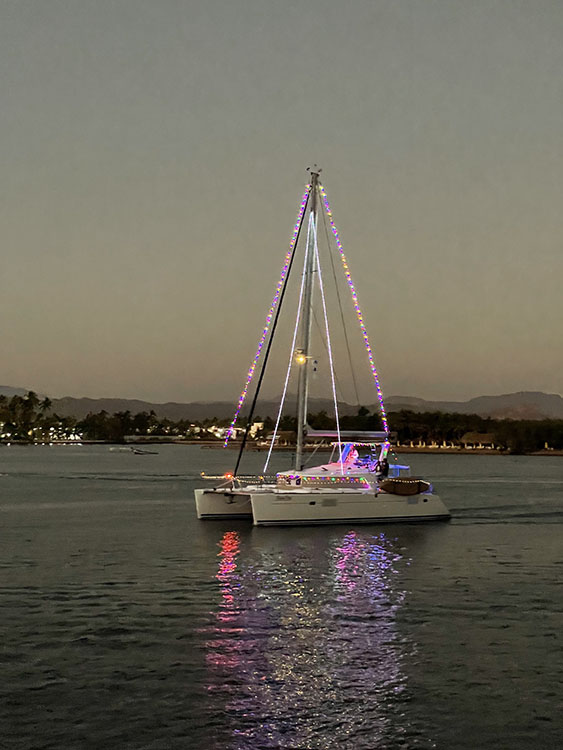
Parade of Lights

We spent Christmas and New Year in Barra. Both were uneventful days for us. We stayed on the boat and relaxed. We left on the 11th of January and headed south for just a day trip to Carrizal, a small, secluded bay. We met some other Panama Posse boaters there. One of them, Bob, came to our boat in his dingy and introduced himself. He was heading south also, so we decided to buddy boat. Early the next day we headed out. We motored overnight to Cabeza Negra. A nice bay with very nice private homes on its shore. That night was rocky making it difficult to sleep, but the next morning the seas were calm, and the day was quite nice. We stayed in the bay and were visited by a whale. It was swimming around our boats with curiosity. It hung around quite a while, then took a dive right under our boat and was gone. The only picture taken showed the whale way too far away.

The next day after a nice rest we sailed/motored to Caleta de Campos. Palapas lined the beach with food stands everywhere. We needed to provision a bit, so we asked a person in a car about the grocery shopping, and he offered to take us up the hill to the town. Thank goodness we got a ride as the hill was quite steep. It would have been a very tiring walk up the hill. He dropped us off at a nice small grocery store where we bought some fresh food, eggs, and a few other items we were low on. The town was very nice and clean, and everyone was very friendly. 

Dinner at Caleta de Campos

We did meet up with another Panama Posse couple and decided to rendezvous at one of the beach eateries, so we all took our dinghies in for dinner. They paddled and we motored in with Bob. The dinner was cheap and excellent! We each had a whole fish with a spicy sauce along with cocktails. When we left the other couple got out and paddled right to their boat. Bob decided to try to go right out, and we hit a wave, then another wave right in our faces. The boat was swamped, and we were drenched. We got out of the boat in the water and pulled the boat ashore to bail it out. A woman with her child came over with a bucket to help. She did not speak any English but smiled the whole time. We finally got the boat bailed and we moved the dinghy over to where we were supposed to depart. That exit was successful, and we made it back to the boat, although we were quite drenched from the incident, so we took another shower to get the salt off and wash out the clothes we had been wearing. It’s a funny story now, but it was not so funny then. 

The next morning the tsunami was announced, and it was hitting the bays up and down the west coast. We were advised by our Panama Posse colleagues to get out of the bay and head at least 4 miles out to sea to not be affected. So off we went, out to sea on our way to Ixtapa. This was an overnight passage. We took our time so we would arrive at first light as we left 5 hours earlier than we had planned, to be safely out to sea when the surge hit.

Sunrise approaching Ixtapa

We entered the channel to Marina Ixtapa at what was supposed to be high tide. A panga came out to guide us in. Well, the tsunami surge decided to hit exactly when we were trying to go in. When we entered the channel, the seas were running out very fast. We grounded for a short period, but I was able to twist and turn the boat with the strong current and shortly freed it. The current was running so fast that at full throttle we were only making 1.5 knots. It was a little scary. After we arrived the marina closed the channel for all boats. 

Ixtapa Marina

We checked in with the Harbor Master and needed to go to the Port Captain in Zihuatanejo to check in there as well. Zihuatanejo is a 15-minute taxi ride away. There have been issues with checking in at Zihuatanejo by other cruisers so we were aware that this check-in would be a bit more involved. They were right. Not only was this the only port where we had to pay to check in and check out. It also was the only port where none of the paperwork was in English. After waiting for a bit and then filling out the 3 pages of forms, we were told to come back the next day to get our stamped paperwork. What should have been a free 1-hour process took about 3 hours and two separate trips to the Port Captain’s office.

Streets of Zihuatanejo

Our friends from Barra, Terry and Nancy came in two days after us. They are on a catamaran, so we hung out on their boat as it has way more room than ours. We stayed in the marina for 10 days and then anchored in Zihuatanejo bay for two nights. Bob stayed in Ixtapa waiting for his wife to join him from the states. 

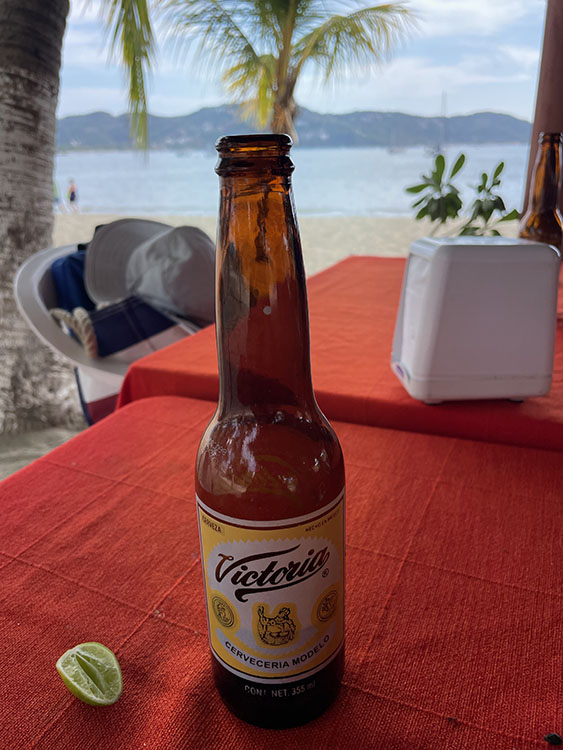
A beer and the beach

We left Zihuatanejo on January 29th for Acapulco, and are now buddy-boating with Terry and Nancy. This was an uneventful overnight motor trip. We met up with another Panama Posse couple Nicole and JP who were in Acapulco waiting for their windlass to be fixed. We were all side tied on the outermost dock of the marina so got to know them. We all went to dinner at a place that was like a Beni Hana if you are familiar with that style of Japanese restaurant. If not, it is where they have a grill, and you sit around it watching your food being prepared. The cook puts on a show as he cooks that is entertaining. The next day we took a hike to where the famous Acapulco cliff divers do their dives. Unfortunately, it was too early for them to be diving, so we missed the show. 

Where they cliff dive in Acapulco

We left the next day for Bahia Chahué. Another overnight motoring trip. Terry and Nancy decided to chance the channel and went in at low tide. They ended up in the mud but were able to get free and dock. Since our draft is a foot deeper, we opted to anchor outside in the bay until high tide. We had no issues with the bottom and were safely tied up at the dock.

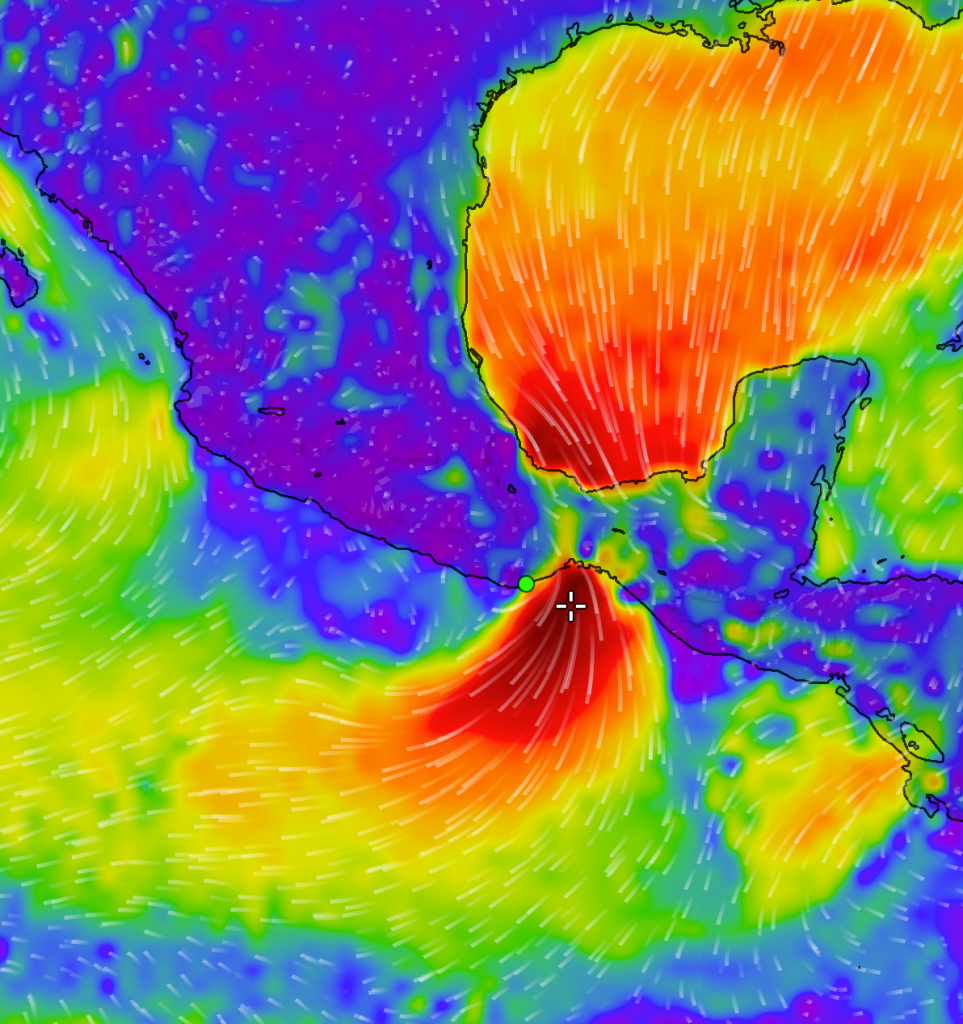
Winds of the Tehuantepec

Marina Chahué is a holding spot for boaters to wait out the strong Tehuantepec winds that blow quite frequently across the narrowest part of Mexico. The Gulf of Tehuantepec is very dangerous for all boats. These winds can blow more than 50 knots. No one, not even large ships, cross it until the winds subside. 

Since the winds had just started blowing and PredictWind indicated the next weather window would be about a week out, we decided to take a road trip to Oaxaca to explore the city and cultural sites. We drove about 5 hours on a winding road that was sometimes dirt and often had areas that were caving in or had fallen rocks scattered around. We rented an Airbnb for three nights right in downtown Oaxaca.

Be careful when renting an Airbnb in Mexico. This place was advertised as a great place, but it was not so great. The floors were dirty. It was advertised as a two-bedroom, but it was one bedroom and an open area. In the kitchen, you had to unplug one appliance to use another. Hot water was only in the shower and the water pressure was so low that the water just dribbled out of the shower head. When someone turned on the water elsewhere or flushed the toilet you got scalded in the shower. 

Mezcal still

On the flip side, Oaxaca is an amazing city and area. The public market was just down the street with lots of activity and many stalls selling many items and food. Oaxaca is known for its Mezcal, chocolate, and mole. We sampled all three and went to two Mezcal distilleries outside the city. Oaxaca is also known for its archeological sites. Just outside the city is the ancient city of Monte Albán. What a great cultural site. 

Monte Albán

We went a different route back to our boats to stop at another archeological site, Mitla, another ancient city in ruins. This one wasn’t as well preserved as Monte Albán. 

We got back to the boat just in time to go check out and leave for Chiapas across the Gulf of Tehuantepec as there was a 3-day weather window approaching. The port captain turned us away to come back the day we were leaving so that he would be assured we wouldn’t leave early. They are very concerned about the safety of boats making the crossing. 

Dolphins!

It was an almost uneventful 2-day crossing of the Gulf. I say almost uneventful because we ran across two long line fishing lines. These are illegal in Mexico, but the fishermen still fish with long lines far enough out to sea so they don’t get caught. Long lines are very long lines with floats and fishing hooks attached to them. They string them out for miles in the open ocean and every boat that comes by gets caught in them or at least must deal with crossing them. The usual course of action is to cut the line to free the boat. We ran across one in the middle of the night and had to cut the line to get free. The second one was during daylight, and we spotted the floats that were spaced about 100 yards apart quite easily. After following the line (it was right across our path) for about 30 minutes I decided I wasn’t going to find the end, so picked a spot midway between two floats and set a course to cross the line. When I reached the line, I put the boat in neutral and drifted across. Watching the floats on either side I could see by their wakes that I had snagged the line. I stopped the boat and with the boat hook was able to push the line off our rudder and free ourselves. Quite an experience I must say. 

Marina Chiapas

We are now at Marina Chiapas, which is the last port in Mexico. There are about 8 Panama Posse boats here, all crossing the Tehuantepec at the same time as us. Some are leaving today or soon. We haven’t decided what we are going to do yet. We want to explore the area as there are Mayan ruins to the east that would be great to see.

Grinding cocoa seeds

Two days ago, on February 22nd, we took a tour of a small Mayan ruin, coffee plantation, and artisan chocolate maker. We had a nice road trip and a very nice tamale meal at the end. The chocolate maker was the highlight of the trip for sure. On our way back to the boat the tour guide stopped at Walmart so we could do some shopping. Very nice.

That’s it for now. Stay tuned for our next chapter. 

Incident West of Brookings, Oregon – Late October 2020

This is a detailed account of what happened in the early morning hours of Saturday, October 31, 2020, about 20 miles west of Brookings, OR.

We were broad reaching in 10 to 12 knots of wind about 20 miles off the southern coast of Oregon on our way to San Diego. Our intended stop was Eureka, CA to rest and take on fuel. The winds had been steadily increasing from total calm to about 15 knots or so. This was deceiving as we were heading downwind, so the apparent wind was much less as we were running between 6 and 7 knots. I was casually paying attention to the wind speed and boat speed and started to see a trend of quickly increasing speed as we started to surf down the waves. The speed increase came on rather quickly and I realized we were carrying too much sail for the conditions, so I headed straight downwind to blanket the headsail with the main. After the headsail was fully furled, I attempted to furl the main, but there was just too much wind in the sail to do it while heading downwind.

I started the engine and turned the boat into the wind to furl the main. As soon as I turned the boat, the full force of the 20+ knots of wind hit us hard, so I released the mainsheet to spill the wind from the main. By this point, we were being bounced around like a cork, and I started to get seasick as I usually do in these kinds of conditions. My wife, Lynette, was below trying to sleep as I had taken the first watch. I could hear loose objects being thrown about and I could only imagine how Lynette was taking it (later she confessed that she was hanging on for dear life).

I have successfully hove to with our boat many times, but for some reason, I couldn’t hold her in a good position under bare poles. I kept the engine running low and in gear to help hold the boat at about 60º to the wind. I would increase or decrease the throttle to keep the wind gauge pegged at 60º, which wasn’t too difficult to do, even while sick. The ride was rough as the waves were coming from all directions. The seas, as usual in the PNW were quite confused, so I switched tack to see if riding to the other tack would be less rough. I really couldn’t tell the difference, so stayed on this tack for the duration. At least I attempted to see what the opposite tack was like.

Sometime after 2 am the engine suddenly quit. I couldn’t get the engine out of gear, so thoughts of a failed transmission passed through my mind. With the engine gone, I could only hold the boat at about 90º to the wind. In most situations that would not be good, but in these confused seas, we were not broadside to the waves.

USCG training photo at the Brooking Bar shortly after the incident

I radioed the USCG for assistance and they mustered a crew to come tow us in. They called every half hour to check on our condition and let us know the progress of the rescue boat. When the boat got closer the skipper radioed us for a current position and asked about our condition, the seas, and the boat itself. I assured them there was no water coming in and that we were fine other than quite sick. The skipper let me know that the seas were much calmer about 6nm to the east. Just our luck that we were 6nm too far off the coast.

Damage to furler and anchor roller

When the USCG rescue boat arrived, they lit up the whole area with their searchlights. It made for an eerie scene. They were going to toss us a line to secure to our bow for the tow, but neither my wife nor I felt strong enough to make our way to the bow. The only option was to have a crewmember land on our boat to secure the line. The first attempt was at the stern, but we are a double-ender and there wasn’t much room for him to land, so they switched to the bow. After a couple of attempts and 2 hard collisions, he was safely onboard. The line was secured, and they started towing us at about 9 knots. A rather loud vibration commenced that none of us could identify, so we slowed a bit to reduce the vibration.

Two and a half hours later we were at the Brookings buoy with the USCG reducing the scope of their tow line to take us over the bar. There were some small boats scattered around the bar fishing, so the skipper asked me to steer our boat directly behind their vessel to keep away from the fishing boats. Once over the bar, they side-tied to us for the final tow to the fuel dock. We tied up around 8 am or so. I was still quite weak but was able to answer questions and accompany the officer on a boat inspection. He indicated that the damage caused by their boat would be covered by the USCG, which was a pleasant surprise to me. He didn’t have any forms with him, so asked me to come by the USCG station in the next few days to pick one up, which I did.

The fuel dock attendant and the USCG personnel were very nice and helpful. They provided information on where to stay, so we booked a room at one of the local hotels. There was a restaurant across the street from the hotel, so we had a late lunch/early dinner and went back to the room to sleep at about 3 pm. We slept until 7 am the next morning. It felt good to catch up on sleep and sleep in a bed again.

The following morning, Sunday, November 1st, we went to the boat. I inspected and took pictures of the damage. Lynette attempted to tidy up the cabin as best she could. When we had docked the day before, I noticed that one of the dock lines was cut short, and a spring line was going under the boat, which was very tight. I was able to loosen the tight line but couldn’t free it. The other spring line had been bound under the tight spring line and when I loosened the tight one, I was able to free the other line. It had not been cut. We had two lines that were good and two lines that had been cut. I assumed that because of how taut the line was that this was what was jamming the transmission in gear. The fuel dock attendant called the boatyard owner, and he came over to discuss hauling the boat out the following day at high tide, around noon.

Crack in the shaft log housing

On Monday, November 2nd, we were side tied to a boat and taken over to the travel lift for the haul out. There was no dock at the travel lift so I remained on the boat as it was lifted and walked off the stern when at ground level. As soon as the boat was out of the water, we could see the extent of the damage. This was not going to be a simple cut the line free and drop the boat back in the water project. The dock line had wrapped three times around where the shaft passes through the shaft log. It was so tight that the area around the shaft housing had cracked. We resigned ourselves to the fact that we were going to be in the yard for a while. Figuring fiberglass work and repainting it would be at least a week.

The hotel we were in was a bit expensive, so on one of our daily walks, we checked pricing at several other hotels and found one that had weekly rates and a kitchen for quite a bit less money. The best part is that the hotel was right across the street from the boatyard. We grabbed food off the boat and settled in for what we thought would be a week’s stay at the hotel.

On Tuesday, November 3rd I was able to take the shaft out of the boat and have it spun up on a lathe to see if it was bent. Unfortunately, it was, so I measured it and ordered another one from Portland to replace it. Meanwhile, the fiberglass person ground off the bottom paint and barrier coat around the shaft log to prepare for the fiberglass repair work.

By Thursday, November 5th, I had a new shaft and the fiberglass work was done. I still had to paint 2 coats of barrier coat and 2 coats of bottom paint, plus install the new shaft. I was worried that the strut had been bent and the shaft wouldn’t turn freely, so slipped the shaft into the bearings and was pleasantly surprised that it turned freely. By Friday, November 6th, I had the propeller, line cutter, and zincs all back on the shaft along with the dripless shaft seal. All that was left was to align the shaft and transmission coupler. I was surprised that everything was still in perfect alignment, so I didn’t have to adjust the engine on its mounts.

First barrier coat applied

On Monday, November 9th, I started the painting process with one coat of Pettit Protect barrier coat in the morning. I needed to wait until Tuesday to put the second coat on, so took the rest of the day off. Tuesday, November 10th, had me putting the second barrier coat on in the morning and the first coat of Pettit Trinidad Pro bottom paint on in the afternoon. The timing of the first coat of bottom paint is critical, as it needs to go on before the last barrier coat completely dries for it to bond to the barrier coat. On Wednesday morning, November 11th, I put the last bottom coat on which finished the project.

The boat couldn’t go in the water for 24 hours after the last coat of bottom paint, so we set a time for Thursday morning to launch the boat. I was at the boat by 9 am peeling off the masking tape and getting the boat ready to launch. While removing the tape from the propeller shaft I noticed that the two weep holes that had been at the forward end of the shaft log cutlass bearing had been fiberglassed over. I don’t know why I never noticed it before, but at least I noticed it before the boat was launched. These weep holes provide water flow to lubricate the cutlass bearing and are necessary to prevent burning up the bearing.

The boatyard owner was able to contact the fiberglass person and he came in to drill out the holes. He easily found one hole but missed the second one. I noticed the second hole hadn’t gone through, so I had him come back to explore for it. He finally found it, but now he had to fiberglass over the exploratory holes he made trying to find the actual hole. This was a huge setback, as it would require going back through the entire painting process after the fiberglass had set. I was disappointed that I hadn’t seen that the weep holes were missing back when I started the original painting. The fiberglass person was also disappointed that he had forgotten to clear the weep holes.

Needless to say, we didn’t launch the boat that day. The boatyard owner felt bad for us and said he wouldn’t charge us for anything more, so my yard days were free from that point on. He also gave me the combination for the yard gate so I could work over the weekend and lent me his truck so we could go to the grocery store to get food. We appreciated all he was doing for us.

On Friday, November 13th, I started the painting process again. The goal was to have it done by Sunday, November 15th, and launch the boat on Monday, November 16th. The painting went without a hitch and we launched the boat on Monday morning as planned. I motored for the first time under my own power back to the transient dock. It felt good and we had no issues. We were back on the boat and anxious to head south. We had been in the boatyard for two whole weeks. The incident took two weeks and two days out of our travel time to San Diego, and I was nervous about leaving Brookings so late in the fall. The locals say, “If you don’t leave Brookings by Halloween you’ll be staying until Spring.”

I had been monitoring the weather using PredictWind since we had arrived in Brookings, so was fairly confident of what was to come. We sat through torrential rains and heavy winds at the dock for two days, Tuesday and Wednesday. There appeared to be a small weather window traveling down the coast that was to pass Brookings on Thursday, November 19th. We hoped to catch a ride on that weather window and have it carry us as far south as we could get, and that is exactly what we did.

Postmortem

I have always done postmortems on things that I’ve been involved with to see if I could learn from them, and if mistakes were made, try not to make them again. What did I learn from this incident? First off, don’t leave dock lines on the deck during a passage. Good grief, I’d be a rich man if I had a dollar for every time I’ve heard that since this incident. Yes, it was a bad thing to do, but I had not thought anything of it as we have high gunwales and have never lost a line over the side, even in seas as bad as we had experienced this time. Well, it was an accident waiting to happen and we suffered the consequences for it. That was the first and biggest mistake that I will never let happen again.

I had just finished reading Lynn and Larry Pardey’s book on storm tactics. They are big advocates of heaving to during a storm rather than running with the storm. So, when I turned into the wind my first thought was to wait out the blow by heaving to. This was my second mistake. Not being able to see the sea before me I immediately thought the conditions to be worse than they probably were. Getting sick was a bonus that just added to the situation. If it had been daylight, I might have taken a different approach. Further south as we were rounding Cape Mendocino, we were confronted with almost the same situation; a quickly freshening breeze with a need to reef while going downwind. The big difference is that this was during the day. As soon as we came about the full force of the wind hit us and we were again bouncing around like a cork. The difference here is that I could see the seas hitting us and saw them for what they were. We reefed and came about to continue our downwind sail under reefed sails. It really would have been that simple that fateful night if I had done the same thing, but without the ability to see, I made these two mistakes that cost us about $12,000 and two weeks.

Down the US West Coast – Fall 2020

Our house was sold. Most of our possessions that wouldn’t fit on the boat were either sold or given away. This was our first big step into the next chapter of our lives. We were excited and apprehensive at the same time. Excited to be going and apprehensive because it was late fall, and we didn’t know what weather we would encounter on the trip. We were ready and we knew the boat was sturdy and strong, so on the morning of Tuesday, October 27th, 2020, at 6:15 am, we pulled in the dock lines and shoved off from McCuddy’s Landing Marina in Scappoose, OR.

Fog, as we made our way down the Columbia River

We were greeted by thick fog as we motored down the channel toward the Columbia River, with Tongue Point as our first stop. We’d made the trip down the channel to St. Helens many times, so even in the fog, it was an uneventful passage with our trusty Raymarine chart plotter.

Fog lifting at sunrise

The fog cleared by late morning and we enjoyed an easy passage down the Columbia River by motor to Tongue Point. We anchored off Mott Island just to the east of Tongue point in about 20ft of water around 6 pm as it was getting dark. We made dinner and went to bed, with the plans to rise around 6 am and be off the hook by 8 am to cross the Columbia Bar by noon.

The next morning, Wednesday, October 28th, was again a foggy morning. We rose at 6 am, ate breakfast, and were off around 8 am, as we had planned. The fog was thick but became even thicker as we continued toward the bar. I am glad we have AIS, as I could “see” every large ship that was anchored or in transit on the river. We had the radar on for those boats that were not using AIS. We were hailed once by an incoming ship to establish our intentions. We agreed to pass port-to-port with our boat staying on the Washington side of the river. There were only a couple of other ships coming in, but they were far enough off that we had no contact with them. The bar crossing was uneventful, and we crossed it near high tide around noon. The fog was lifting, and we could see it was turning into a beautiful day. We even had decent wind.

We decided before the trip to go as far as we could go toward San Diego as long as the weather held. We have a PredictWind account and were monitoring weather and wave conditions in real time while we were close enough to the shore to have a cellular signal. It appeared like we could make it to Eureka, California with good weather, so that was our current plan.

A brisk wind heading south from the Columbia Bar

The wind was steady the first afternoon and we sailed using our Hydrovane wind vane to steer. At some points, we were beam reaching around 5-6 knots. When our speed dropped to 3 knots a few times we switched to motor sailing just to keep our speed up. The seas were relatively light with only the pesky NW swell causing us to roll from time to time.

As it got dark the wind became very light. We had dropped the sails and were motoring around 5 knots at around 2000 rpm. Since we had a new engine, we were varying the speed, as the manual stated that it was good to vary the speed while breaking in the engine. So, we varied the RPMs from about 1500 to 2200 regularly, stopping at 2000rpm in the middle for a while. We weren’t in a hurry, as it appeared we had a good weather window to reach Eureka.

Our first sunset on the Pacific

As night approached, we hadn’t decided how to handle taking shifts. Since my wife, Lynette, doesn’t usually fall asleep until after midnight, she opted to take the first shift from about 7 pm to midnight. She made it to 11 pm and woke me as she was having difficulty seeing ahead and didn’t want to run into anything, so I took over and made it until about 6 am when I woke Lynette to take over.

Thursday, October 29th, was uneventful. Some sailing, some motoring depending on the wind. We were about 15 miles offshore and doing reasonably well. Neither of us was sick, but we still didn’t have our sea legs, so were a bit out of sorts. We ate light and watched the miles slowly pass by. Every once in a while, a boat would show up on the AIS, but for the most part, we were alone and enjoying good weather. As night fell, I took the first shift and Lynette took the second from 11 pm to about 3 am. I was still doing the brunt of the watches but was ok with that as I wanted to ease Lynette into taking the watch at night. She did great and I got some sleep.

Very calm

Friday, October 30th, started with some decent wind and we broad-reached for quite a while. By midday, the wind was gone, and we were becalmed. The seas were so glassy that I decided to stop to change the transmission oil and fill the diesel tank from our two 5-gallon jerry cans. After those tasks were finished, we motored until late afternoon when the wind picked up. That afternoon until early evening was the best sailing we had done on this trip. We were on a very consistent broad reach that netted us 6-7 knots.

Around 7 pm, I noticed we were starting to surf down the waves as our speed began to increase with the increase in wind speed, which was now between 15 and 20 knots. I realized I had too much sail up, so tried to furl the sails while heading downwind. I got the headsail furled but couldn’t budge the main as it was carrying too much wind. I had already started the engine, so motored around to face the wind. I was then able to furl the main and using the engine, ran bare poles into the wind, which was now gusting over 30 knots. The seas were confused, and we were being bounced around like a cork. Every time I am in those conditions I get sick, and like clockwork, I got sick. I was using the engine to help hold us at about 60º off the wind in a heave-to position. For some reason I couldn’t hold us in that position without using the engine, so kept it going.

The conditions continued to deteriorate, and I continued to be very sick. It was all I could do to keep the boat heading at 60º to the wind. I had no fear we were in danger as I knew the boat was strong. I was more frustrated that I was so sick and felt helpless and weak from vomiting. Around 2 or 3 am, the engine quit suddenly. I had no idea why but decided to call the USCG for a rescue, as I had no idea if the storm was going to blow out or get worse over the next few hours. The USCG mustered a boat crew and headed out to tow us in. It took about 2.5 hours for them to reach us. Along the way, they were in touch with us every half hour to get our position and ask how we were doing. During one of the first conversations I had with the skipper, she said that about 6nm to the east of us the conditions were much calmer. Go figure, only 6nm too far offshore.

Brookings USCG training photo from early November 2020

When the USCG arrived, they offered to throw us a tow line. Neither Lynette nor I felt able or strong enough to go to the bow to retrieve the line, so plan B was to land one of their crew on our deck in the rough conditions. They were successful at landing a crew member on deck after about 3 or 4 tries. Unfortunately, not without damage to our bow stem fitting and anchor roller. With us in tow, it took about 3 hours to tow us to Brookings, Oregon.

We arrived in Brookings on Saturday, October 30th, and discovered that two of our dock lines had gone overboard and gotten tangled in the prop. We have a line cutter on the prop, so the lines were cut and not tangled in the prop, but the zincs on the prop shaft must have caught one of the lines and jammed the line between the prop shaft and the hull at the shaft log. What came next is a topic for another article, as we were on the hard in Brookings for about 2 weeks getting repairs done.

Fast forward to Thursday, November 19th, when we were finally able to leave Brookings and continue our journey to San Diego. This was our first weather window after splashing the boat on Monday, November 16th. It was an iffy window, but we were both getting anxious to leave. Winter was coming and the weather windows that I had been tracking were becoming fewer and fewer. The saying in Brookings is if you haven’t left by Halloween, you aren’t going to go. It was November 19th, so to say the least, we were anxious.

The previous two days had been windy with rain, so the seas were still a bit big. I called the USCG around 7 am to check on the bar conditions as there was a small craft warning for the bar, but it wasn’t closed. They said 30ft and under were restricted. I told them we were 40ft, and they said to stay in the middle of the channel and be careful.

The Brookings marketing material states that the Brookings bar is the least dangerous bar on the coast. Well, that morning it was showing its teeth. The crossing was very rough with rather large waves and deep troughs. Lynette and I commented to each other that these bar conditions were worse than any crossing we had done at the Columbia Bar. We’d crossed that bar at least half a dozen times with no incidents. It was an interesting experience for our first day out following our “adventure” two weeks prior. To say we were apprehensive was an understatement. We had been wishing for a bit better conditions but felt we had to push on to keep within the current weather window (the weather looked nasty coming down from the north).

Not so sheltered cove

Our goal was to see how our stomachs felt and take it easy to Eureka. We made it to Eureka in great time motor sailing and found that due to the high seas the bar was closed. It was mid-day on Friday, November 20th, so we hove to for a few hours to see if the bar would open. It didn’t, so we pushed on. We chose to anchor overnight at Shelter Cove and got there just as night was setting in. Having never been to Shelter Cove, we tiptoed past the buoys and found a spot in about 30ft of water to anchor. I was trying to get us tucked up into the cove as far as I could to avoid the NW swell. We didn’t get far enough in, so consequently, we had a night of constant rolling. Ugh, I almost got seasick again, as the boat would roll from side to side quite violently and then stop maybe for 3 to 5 minutes, then it would start again, over and over again, all night long. We couldn’t wait for the morning so we could get underway.

As soon as the day broke on Saturday, November 21st, we started the engine and weighed anchor. Because the bow roller had been damaged, I had quite a bit of difficulty retrieving the anchor. The chain would hang in the gypsy due to the extra drag the roller was causing. It took about half an hour to finish weighing the anchor. That was the last time we anchored during our voyage, as I didn’t want to repeat that ordeal.

We checked the weather and it looked good, so we headed south not knowing where our next stop would be. Again, light winds, so mostly motoring or motor sailing. With the stem fitting damages I didn’t want to put undue strain on the forestay, so didn’t use the headsail for the rest of the journey. Luckily, we are cutter rigged, so we deployed the staysail as an alternative. It’s smaller, but still quite functional.

While on the route south Lynette spotted two whale spouts off the starboard bow about 50 yards. One was larger than the other, so we assumed a mother and calf. A few minutes later we saw a very long pectoral fin come out of the water, signifying these were humpback whales. That was our only brief encounter with whales, but we felt fortunate to have not missed the encounter.

Spud Point Marina, Bodega Bay

Next stop, Bodega Bay. The weather was starting to collapse a bit, as we closed in on Bodega bay, so we opted to tuck in there for a few days to let the blow go by. We arrived mid-day on Sunday, November 22nd. Spuds Marina is tucked in rather far from the entrance to the bay, so there was a bit of negotiating crab pots and channel markers to get there. We took on fuel and were assigned an end tie for the night. After settling in, we checked the weather and decided it was necessary to stay for two nights, so paid for a second night at the dock.

Bodega Bay is a quaint little town with a history of where the Alfred Hitchcock movie, The Birds, was filmed. Unfortunately, without transportation (no Uber, or Lyft and only a bus once a day) we were stuck wandering around the docks. We did laundry and ate a late lunch at a fantastic small restaurant across the street from the marina. We had the best clam chowder we had ever eaten.

The tourist trap at Bodega Bay

The next day we opted to walk into town to get groceries as we were running low on supplies. We got local advice as to which store was better (there were only two) and headed out for the 1.2-mile walk into town. It was a nice walk that took us past the café that was used in the movie, so took a picture of the sign. We didn’t stop as there were lots of people there being tourists. With groceries in hand, we walked the 1.2 miles back to the boat and settled in for the night.

My first helping of Thanksgiving dinner

Early on Tuesday, November 24th, we left the docks and headed to Monterey. Again, an uneventful motor sail down the coast. On approach to Monterey on Wednesday, November 25th, I called my nephew to let him know we were going to be stopping in Monterey. He lives in Hollister, which is about 45 minutes from Monterey. He offered to put us up in a hotel and have us come to Thanksgiving dinner the next day, so we checked the weather and saw that a storm was going to blow in that wouldn’t allow us to leave until Friday, so we accepted his offer. This was to be a great diversion from our travels and an opportunity to spend some time with family. It was a wonderful Thanksgiving.

We fueled up and left Monterey on Friday, November 27th at noon. The seas were calm, and the winds were very light, so we spent the day motoring south. We still were anxious to get as far south as possible before the next storm rolled in, so continued to motor at about 5 to 5.5 knots. Our immediate goal was to get south of Point Conception, where it seemed the weather was more stable.

Our original plan was to stop at Morro Bay to see Lynette’s cousin and family, but after reading about the approach, decided to forgo stopping and kept heading south. We weren’t tired and both of us were feeling pretty good. Our motto was to keep heading south if the seas and winds were favorable. So, we did just that. Also, in our original plans, we were going to anchor at one of the Channel Islands as an overnight, but due to the anchor roller damage and the difficulty we had weighing anchor at Shelter Cove, we decided not to. We didn’t even discuss pulling into Santa Barbara as we didn’t want to waste the time. The weather looked good, and it seemed like we could make it to San Diego without rough seas or heavy winds, so our goal changed to continue to San Diego non-stop.

This last passage was so uneventful that it was almost boring. I decided to accidentally spice it up by taking the inside passage past the Channel Islands where I thought we would be shadowed from the NW swell. After committing to the inside we did lose the swell but didn’t plan on so much large ship traffic. Lynette didn’t feel comfortable taking a shift with so much traffic, so I managed to do an all-nighter staying out of the way of the big ships. The shipping traffic separator ran pretty close to the islands, so we hugged the islands all night long. We were just passing between Santa Cruz and Anacapa Islands as day broke on Sunday, November 29th. After the Channel Islands were at our stern I was greeted by a shoal of porpoises. They didn’t hang around long, but they did put a bright spot on my morning. Lynette missed them as she was still sleeping.

Our first porpoise encounter

The wind came up for a bit and we sailed at 4-5 knots for a while until our speed dropped to around 3 knots and we went back to motor sailing. Late in the afternoon another shoal of porpoises came and played in our bow wave for quite some time. I decided to get some photos and do a movie but found after I got back to the cockpit that I had mistakenly thought the red light on the phone was indicating I was recording, when in fact it was indicating the opposite. The only movie footage I got was of me walking back to the cockpit. Oh well. I still had some images of them playing in the bow wave.

Moon over Catalina Island

As we approached Catalina Island that evening, I decided to take the outside route as I didn’t want a repeat of the traffic we had passing the Channel Islands. We reached Catalina at sunset, with the full moon rising over the island. It was a picture moment. Lynette took the first watch and I slept. When she woke me around midnight we were almost to the end of the island. Once clear of Catalina I shifted course and headed directly toward Point Loma at the entrance to San Diego bay. All the while just motoring as there was next to no wind.

Sunrise on approach to San Diego
A peek at the San Diego skyline

We entered San Diego harbor around 11 am on Monday, November 30th, and called the marina in Chula Vista to let them know we were getting close. By that time, we were motoring on fumes, having not fueled since Monterey. Except for the brief sail on Sunday, we motored the entire distance. Our new Beta 43 engine did us proud. We averaged 0.6 to 0.8 gallons per hour. I called the marina and they said they didn’t have a fuel dock, so we backtracked a mile to the closest fuel dock on Harbor Island and filled the tank and jerry cans.

We arrived and docked without mishap around 3 pm. The journey was finally over. It had seemed like a whirlwind trip bypassing all the interesting places to stop, but after losing 2 weeks in Brookings, we felt we needed to get it over before the weather got worse. Even though we lost 2 weeks and had to spend the money to stay in a hotel and fix the boat, we were able to put a positive spin on the incident. We met some great people who helped us while we were there, and if we hadn’t been delayed, we wouldn’t have had the opportunity for the fantastic family Thanksgiving dinner at my nephew’s home. What a great voyage!

Chula Vista Marina

We’re here in San Diego with family nearby. We did Christmas with Lynette’s daughters and have been enjoying the warmer, sunnier weather. Boat projects and a sail to Catalina are in our future for this spring. After that, who knows? We had originally planned to do the 2020 Bajahaha, but it was canceled due to the pandemic. Maybe later this year things will have settled down and we can continue our journey south. Here’s to a better 2021. Happy New Year!

Watermaker Install

Having a watermaker onboard or not can be an interesting debate. There are numerous posts in online forums on the subject if you desire to go down that rabbit hole. My wife, Lynette, and I discussed the subject for some time and decided it was important to be freshwater independent; meaning that we would never have to plan our stops around water. We had also heard that if purchasing a watermaker, buy the largest capacity watermaker that fits your budget. I’ll add to that; buy the largest watermaker you can fit on your boat.

We decided to purchase a 30gal/hr 120vac unit from CruiseROWater. The decision wasn’t an easy one, as there are many choices. I knew I wanted a kit that used off-the-shelf components, as the drop-in units often use proprietary components that can be difficult to source and expensive to replace. An off-the-shelf watermaker kit made sense, as these systems are usually basic and simple. This meant I could find the parts and repair the watermaker myself if and when it needed fixing.

A very important step not to skip

Before we purchased the watermaker, I needed to know if all the components would fit in the boat and where they would fit, as watermakers are not tiny. A 30gal/hr unit requires two 44˝ pressure vessels, and I wasn’t sure I had room for two. I certainly didn’t want to purchase two pressure vessels and find out I only had room for one.

RO pressure vessels
High-pressure pump

Most watermakers have two large components, and various smaller components, hoses, and tubing. The reverse osmosis (RO) pressure vessels are 44˝ long and about 3˝ in diameter each. The high-pressure pump that forces the water through the RO membranes has a rather large and heavy 1hp electric motor with a high-pressure pump attached to it. It’s about 10˝ in diameter and 18˝ long and weighs about 50 pounds. Both the pressure vessels and the high-pressure pump need homes on our boat.

I usually make cardboard mockups of large things to ensure they will fit in the space intended. I’ve done this with our holding tank and freshwater tank. This gives me the ability to move the mockup around to find the best fit. In my opinion, this is the single most important step to installing anything that has any size to it. So, I bought some 3˝ in diameter mailing tubes and cut them to the exact size of the two pressure vessels. I then mocked up the high-pressure pump with some cardboard to simulate its relative sizes.

Available space

After a bit of trial and error, I was able to find a place under the cabinet behind the port settee where both pressure vessels would fit. Normally the pressure vessels are mounted with hardware that sets the two side-by-side. I didn’t have the room to do this, but I did have the room to mount them individually in that space. This would require separate mounting hardware and an extra hose with different hose fittings to connect the two pressure vessels. I consulted with the manufacturer on this and they said it wouldn’t be a problem.

The only place I found where I could mount the high-pressure pump was under the “L” portion of our port settee. There physically was room, but the hull slopes up in that area, so I needed to build a shelf to sit the high-pressure pump on. After testing these locations with my mockups, I was confident they would fit, so I placed the order for the 30gal/hr watermaker.

Installing the components

The instruction manual that comes with this watermaker is quite complete. It details how the components go together, the flow of both salt and fresh water, and how to wire the two pumps. Exactly how it all fits together is determined by the location of each component from one another and the obstacles the hoses and tubing have to go around or through.

Installation drawing

After studying the manual, I used Adobe Illustrator to make a drawing of how the components would be connected within the space I had available for them. I went through several iterations of drawings until I had one that I felt worked best. I now had a drawing that showed every valve, elbow, and length of tubing I needed, and how they would fit together.

The kit came with quite a bit of tubing of several sizes and a bag of fittings. I took inventory of the fittings to see if I had the fittings I needed based on my drawing. I was shy a few, so I found a source online to purchase the extra fittings I needed.

It seemed best to install the two largest components first, the pressure vessels and the high-pressure pump, as these could only be mounted in the spaces I identified for them using the mockups. As they were big and heavy, they were going to take the most time to mount. All the hoses, tubing, filters, and boost pump were small, and I had enough room in the locker to mount them without issue.

New access hatch

Our boat had one access hatch for the “L” portion of the settee. This didn’t give me enough room to mount the high-pressure pump, so I cut a second hatch over the space where the pump was going. I then built a plywood shelf and epoxied it onto the hull. This took a bit of time, but I felt it was necessary for a proper installation of the heavy high-pressure pump.

Rubber motor mounts

The high-pressure pump motor has a metal base with four bolt holes to attach it to the shelf. It didn’t come with any vibration dampening mounts, so I found some online that would do the job nicely. These mounts would prevent the motor vibration from transferring to the hull, hopefully keeping the noise from the motor down a bit. Before I mounted the motor, I connected the wiring and pressure relief valve tubing as they would have been difficult to connect once the motor was in place.

Pressure vessel installation

Next, I mounted the pressure vessels under the cabinet. Other than being a tight fit, I was able to get them mounted easily with some help from my wife. I also attached the high-pressure hoses and the freshwater tubing at that time so the pressure vessel portion of the installation would be complete.

The water flow for the watermaker requires two through hull fittings; one for the seawater intake into the watermaker and one for the waste brine to exit. I already had a through hull for the intake, so I only needed to drill a hole above the waterline and mount a small through hull for the waste brine.

Once the through-hull was mounted, I installed the three filter housings and connected the components with the tubing and fittings as per my drawing and the instruction manual. The locker below the settee didn’t have enough headroom to unscrew the filter housings and remove the filters, so I had to cut holes in the floor below the filter housings to allow the housings to be lowered enough to get the filters in and out. Luckily I had about 4˝ of space between the hull and the floor of the locker. I decided not to mount the boost pump until I had all the tubing installed and the hose from the through hull installed. That way I could place the boost pump exactly where it needed to be to connect to the tubing and hose.

Control Panel

Probably the most difficult task was to snake a ¾˝ hose from the through hull under the galley sink to the locker where the watermaker was being installed. It was about a 15´ run and required drilling some holes in very inaccessible locations to get the hose installed. At the same time, I wire-tied two ¼˝ tubes that supplied fresh water to the water tanks and sample water to one of the sink foot pump faucets for testing. This way, when I installed the ¾˝ hose the two tubes came along for the ride. Once the ¾˝ supply hose was installed I was able to install the boost pump in exactly the correct location to connect to the supply hose.

This watermaker has a very nice control panel with everything needed to run the watermaker. I cut a hole in the side of the settee to mount the control panel. Some of the tubing and hoses had to be attached to the back of the control panel. Once that was done, the liquid side of the watermaker install was finished.

Our watermaker uses both 120vac and 12vdc. I had to add a breaker to each electrical panel and run two sets of wires from the panel to the watermaker control panel. The 120vac is for the high-pressure pump and the 12vdc is for the boost pump. I wired the high-pressure pump into the normal house 120vac panel so I could use the inverter to power the watermaker when the engine was running or hook the Honda generator to the shore power cord to run the watermaker when we weren’t running the engine. That way I had two sources to power the high-pressure pump that were convenient to use.

Commissioning the watermaker

Finished installation, top view
Finished installation, full view

Once the electrical was done it was time to test for leaks and commission the watermaker. We made a short trip out of the marina in Barra de Navidad to be in clear water for the testing. The instruction manual gives great instructions on commissioning the watermaker, so after reading that portion of the manual, I proceeded to test the watermaker. As soon as both pumps had run for a bit and the air was purged from the system, I increased the pressure on the RO membranes. When the RO membranes had about 800psi of saltwater pressure the watermaker was making about 30gal/hr of fresh water. I then checked for leaks all along the plumbing. Luckily there were no leaks.

Watermakers require frequent freshwater flushes of the membranes when not in use to prevent the buildup of bacteria and organisms. I set an event in my Google Calendar to remind me every three days to switch on the freshwater flush for 3-5 minutes. Some watermakers have a feature to do this automatically. Ours had an option we could purchase, but we decided it was simple enough to do it manually. Less to go wrong in my opinion. Yes, I have to remember, but it’s not the end of the world if I forget one time here and there. If we plan to be gone for an extended period, I will just prepare the membranes for extended storage. This is called pickling the watermaker and isn’t too difficult to do.

In summary

Plan, plan, plan, and read the manual. Installing our watermaker wasn’t an overly complicated process. Simple knowledge of plumbing and electricity is necessary, along with the ability to read a manual and follow the instructions. Building both physical mockups and digital ones in Illustrator was important for me, as I like to have a plan I can follow.

We can now make water anytime we want as long as we are in reasonably clean water, which is usually when we are on passage. We’ve filled the two 45gal tanks multiple times now and the water tastes great. We are now finally freshwater-independent!

Repower with a Beta43 engine

When we purchased our 1980 Fast Passage 39, No Regrets, back in 2004 we felt the Perkins 4.108 engine was a good, solid engine with low hours. We had no intention or budget to replace the engine. However, we did a major refit of the boat over the next 15 years, including all new wiring, plumbing, standing rigging, running rigging, sails, dodger, bimini, and electronics. Of course, the refit took longer than we ever anticipated, partly due to available funds and partly due to a lack of available time. Probably the single biggest gain from this refit is that I know everything about all the systems on the boat, so maintaining these systems should be easier to do myself.

With only a few non-critical items still left on our to-do list, we did a shakedown cruise up the coast of Washington in 2018. We noticed that the exhaust had some light gray smoke, which hadn’t been present on previous trips. During this shakedown cruise, we put about 100 hours on the engine and consumed 1.25 gallons of oil. Yes, that’s 1.25 gallons! Luckily, we had that much spare oil on the boat, so we were able to keep the engine running.

We had no idea where the oil was going. If it was being burned, there would have been some reasonably heavy black smoking trailing behind the boat and the transom would have been black with soot. Neither of which had happened. So where was it going?

Old Perkins engine front

I contacted our boatyard and asked them whom they would recommend looking at the engine. I contacted that person and had him come to the boat to check out the engine. He was stymied as it wasn’t clear where the oil was going. The engine sounded strong and started immediately with no issues. We had an oil analysis done, indicating some metal in the oil, but nothing serious. He suggested a compression test and if there was a cylinder with low compress, do a leak-down test on that cylinder to identify where the leak was. So, I purchased a diesel compression tester on eBay and then purchased a leak-down tester online. The compression test indicated I had lower compression on the #1 cylinder, so I performed a leak-down test on that cylinder. The leak-down test showed that the intake valve wasn’t sealing. This prompted a head rebuild, so I took the head off and had it rebuilt.

Old Perkins engine rear

Once I reinstalled the rebuilt head, we took two separate trips around Sauvie Island. On the first trip, we consumed about 1/2 quart of oil in almost 8 hours. The second trip showed we hadn’t consumed any more oil. Success? I wasn’t convinced we wouldn’t have more issues down the road and had lost my confidence in the engine. The Perkins was built in 1979 and we were planning an extended voyage outside the USA. It was time for some serious discussion and thought.

I did some research to get an idea of the cost of new vs. rebuilding the Perkins. My wife, Lynette, and I discussed options and costs. We both agreed that a repower was in our immediate future, as it was the only way we would regain confidence in an engine. Yes, we could have rebuilt the Perkins, and there’s plenty of information online stating that the Perkins 4.108 is an excellent, well-built engine that still has parts available. But we would have a rebuilt 1979 engine that could cost 1/2 to 2/3 the price of a new engine.

I had already done a significant amount of research online reading about all the different options for a new smaller marine diesel engine. I wanted a low rpm engine (under 3,000rpm) that didn’t have all the electronic controls the newer common rail engines have. I wanted an engine I could repair that didn’t rely on electronics to run. Plus, I wanted parts to be readily available worldwide. These needs lead us to Beta Marine from the UK. They marinize Kubota tractor engines and have been doing so since 1987. Beta Marine engines met all my criteria stated above. We now had our engine manufacturer, but what size?

I had read that many sailboats have engines that are too large for the boat and therefore are not put under optimum load. Diesel engines like to be run with a good load, and an engine that is too big for the boat can be run without enough load to keep them in an optimum heat range. More load on an engine means the engine will run at a higher temperature, which is better for the engine than being run with too little load, causing the engine to run at a cooler temperature.

With this research, we opted to replace the 50hp Perkins with a 43hp Beta. This saved us several thousand dollars over a 50hp Beta and roughly 150 pounds over the existing Perkins. Beta makes a conversion kit that would allow us to use our existing Velvet Drive transmission. Unfortunately, that combination was too long to fit in our engine compartment, so we opted to go with one of Beta’s standard transmissions, the Technodrive TMC60A, which has a 7º down angle for the driveshaft. The 7º down angle allows the engine to be installed quite low in the engine compartment keeping the weight low and giving us some much-needed space above the engine.

Since I had done most of the refit myself, I also wanted to do most of the repower myself. Hopefully, this would save some money and allow me to know as much as possible about the engine installation so I could perform most repairs myself.

The boatyard told me that outside the cost of the engine a significant cost of a repower was in rebuilding the engine mount rails to fit the new engine. Based on this, I wanted to use the same engine mount rails that the Perkins sat on with no modification. This would require less customizing of the engine compartment and hopefully save us money. Since the Beta 43’s motor mounts are in different locations than the Perkins motor mounts it would require customizing the engine mounting feet. Beta offers this service and has several customization forms to provide the measurements needed to fabricate custom feet.

I have some skills in using Adobe Illustrator, so I used that program to draw the engine compartment to scale. Beta has CAD drawings of their engines with different transmissions that I was able to import into Illustrator. I played with several transmissions attached to the engine to see which one would fit in the engine compartment best. This is how I chose the TMC60A as the transmission. It fit the best and didn’t add additional cost to the engine, as it was one of the standard transmission options.

Engine drawing in Illustrator

From there I played with different positions for the engine and transmission that would require the least amount of customizing of the engine compartment. Once I arrived at the best fit, I filled out the customization forms and sent the forms and my plans to Beta. They entered the measurements in their CAD program and sent me back the resulting CAD drawings. I placed those drawings into Illustrator to see how the motor mounts would fit. It took about 4-5 tweaks back and forth before we had the final solution.

The fit of the engine was going to be quite tight in the engine compartment, so I had Beta configure the engine with the oil filter in the rear above the transmission, which made it much easier to change the filter. Normally it’s down low and on the forward starboard side of the engine. Beta makes a remote oil filter kit, so I had them make a mounting bracket to hold the filter above the transmission. That was a very good decision as now the filter is easily accessible and mounted vertically instead of horizontally (no oil running all over the place when changing the filter).

Old Perkins engine, ready for removal

With the planning and configuration behind us, Beta started the build process on our engine. It took about a month to receive the engine. Before the engine arrived, we hauled the boat, and I began dismantling the Perkins for removal. I wanted to make it as easy as possible to remove the old engine and protect the woodwork from damage, so I padded everything that could get damaged with 1/2˝ thick honeycomb cardboard and pipe insulation to cover corners. I took everything that was attached to the engine, including the head, off the engine. I didn’t remove the transmission until we had the crane over the boat and the cable wrapped around the transmission to haul it out. From start to finish once the crane was over the boat, it took about 1.5 hours to get the old engine and transmission out of the boat and onto a pallet that I built for the engine.

Engine bed, ready for new engine

With the engine out of the boat and while waiting for the Beta to arrive, I cleaned and repainted the engine compartment. I filled the old mounting holes as the new feet didn’t fit those holes. I also remeasured the entire engine compartment to make sure my measurements were correct, as it was difficult to take accurate measurements with the engine in place. I’m glad I did as the measurements had been slightly off.

When the engine arrived, I unboxed it and prepped it to lift into the boat. This meant taking some things off like the alternator and a few other items that stuck out. I didn’t want to completely dismantle the engine as I had done with the Perkins as it was a new engine ready to run. I didn’t even want to remove the transmission if at all possible. We swung the engine into place over the companionway and lowered it into the boat. We needed to turn the engine 90º to move it into the aft berth and then another 90º to position it for insertion into the engine compartment.

New engine, on its way to the boat

I must say, getting the new engine into the boat was a major task. It’s a tight fit with very little room to move the engine. The engine compartment is situated between the aft berth and the galley. It occupies space under a bureau in the aft berth and one of the counters in the galley.

So here we were with a 500-pound engine hanging off a cable in the middle of the companionway with no room to turn the engine 90º. I grabbed some wrenches and started removing other parts that were still attached to the engine. Finally, I had enough off the engine that we could turn it 90º and get it into the aft berth. We put some boards down to slide the engine into place, and I attached a come-along between the front of the engine and the mast and ratcheted the engine into position. Whew! The engine was finally in position. All this took about 2.5 hours.

New engine hanging in aft berth

Because it was costing us money to be in the boatyard, we decided that I wouldn’t finish the install at the yard, but rather tow the boat back to my slip to finish the install at my leisure. Since the engine and transmission were shorter than the old engine, we had to purchase a longer propeller shaft, which couldn’t be fabricated until the engine was in position, as it was necessary to have a very accurate measurement for the shaft length. This meant I had to position the engine in its final position and bolt it down. To do this I purchased a shotgun sighting laser and installed it in an aluminum tube that fit tightly inside the shaft log. I then shot the laser at the coupling on the transmission and moved the engine and transmission up, down, left, and right so the laser dot was positioned in the middle of the shaft coupling. We then drilled holes and bolted the engine in place. I then measured the length for the shaft and had it fabricated. Once the shaft arrived, we installed it and splashed the boat.

Since I had unlimited towing with BoatUS I asked TowBoat if they would tow my boat back to my slip. Since I hadn’t used the towing service, they said they would do it for free, so off we went to our slip with the TowBoat side-tied to our boat. All this went without a hitch.

Exhaust elbow fitting

Over the next couple of months, I finished installing all the electrical, plumbing, exhaust, and fuel systems. The exhaust elbow needed to be customized, so I used some 2˝ PVC pipe and elbows to construct a model for the fabricator. He used the original exhaust elbow cutting off some elbows and tack welding them back on for a dry fit. The elbow didn’t quite fit right, so I took pictures and showed the fabricator what needed to change for a perfect fit. He made the modifications and finalized the welds. The customized exhaust elbow fit perfectly.

Once all the systems were connected to the engine it was time to start the engine for the first time. A quick push on the starter button and the engine started immediately. I found two leaks, so stopped the engine and spent some time trying to fix a leak around a hose going to the heat exchanger and a leak around the coolant filler cap.

After several email conversations with Beta, we identified the issues. I found that the radiator cap leak was caused by a bent coolant cap filler neck (where the cap is attached to the engine). The leak at the heat exchanger was due to a poorly made bronze casting that had a hole in it. A quick email to Beta Marine and we had replacement parts on their way. Once I installed the parts, we had no more leaks!

New engine, almost finished

Success! We now have a new engine that is way better than the Perkins and more importantly, we have an engine we have confidence in. Total cost is a bit difficult to establish, as we always wind up doing multiple projects while on the hard. We replaced the rudder, changed the 3-blade MaxProp to a 4-blade MaxProp, and realigned the propeller shaft strut as it wasn’t quite in alignment, causing some wear on the strut cutlass bearing. Plus, we had the ablative bottom paint sanded off and two coats of hard bottom paint put on. So, after all this, my best guesstimate is somewhere slightly less than $20,000. The engine with customization and shipping was about $16,500. This included a 220 Amp Balmar alternator, MC614 regulator, and a coolant expansion tank as our water heater is above the engine, requiring a coolant expansion tank to be installed above the water heater to prevent air pockets in the coolant lines. We now have about 120 hours on the new engine traveling down the coast to San Diego with no issues at all. The engine ran at about 170º F, consumed no oil, and had enough power to motor between 5.5 and 6.5 knots (depending on conditions) at about 2000rpm using between 0.6 and 0.8 gallons per hour. Wide open throttle pushes the boat at about 7 knots using about 1.3 gallons per hour. We’re very happy with the Beta engine and the refit.