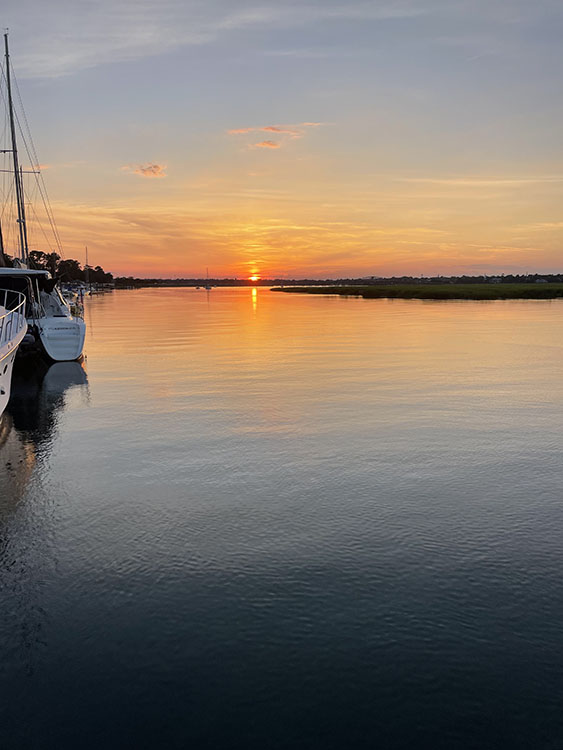
Lady’s Island Marina in Beaufort, SC is where Cerca Trova summered before our ownership, and the previous owners had a reservation for 2023 that we took over. We decided to stay at Lady’s Island Marina for a month to do some repairs and settle in for a bit. It was nice to have a little stability for a change. Constantly moving on almost a daily basis can take its toll.
The marina has an old pickup truck they lend to their slip customers for an hour at a time. Frankly, one hour is not enough time to go grocery shopping, but they were firm on the time. We just never got the truck back within an hour. It was usually an hour and a half, but they never complained.
Many packages were waiting for me when we got to the marina, so I got busy with the repairs the next day. The list was quite long:
- Replace the freezer compressor fan with a more powerful one to help with cooling
- Replace the burned-out starboard engine blower
- Replace the Furuno PG700 heading sensor (electrical storm damage)
- Replace the Furuno IF-NMEAFI analog to NMEA2000 converter (electrical storm damage)
- Replace the poorly crimped butt connector between the alternator and the Sterling Alternator Protection Device
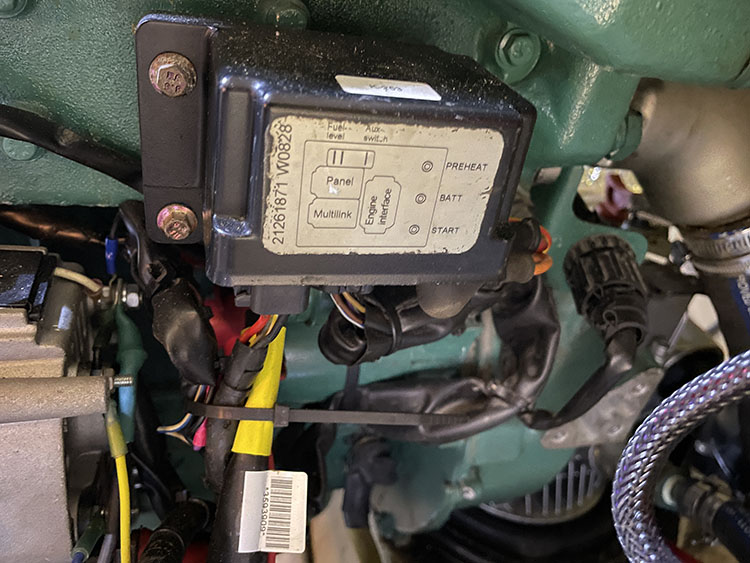
- Remove the dead Volvo Penta MDI (Mechanical Diesel Interface) black box on starboard engine and test the Multilink cable for continuity
- Change all watermaker filters and clean the strainer
- Replace starboard engine tachometer with a rebuilt one
- Add 5″ duct from refrigerator/freezer compressor fan to washer/dryer locker
- Replace defective inlet pressure transducer on watermaker
- Replace the dead MDI box on starboard engine with a new one
- Add stainless screens to the four engine vents and the galley stove vent to prevent bugs and other critters from entering the boat
- Have someone climb the mast to install a new wind transducer (electrical storm damage) and remove the TV antenna
- Rewire the entire NMEA2000 electronics network properly
- Replace the empty propane tank with a full one
- Replace copper ground foil for SSB radio
- Replace wrong size hose clamp on the water inlet to the aft washdown hose to stop it from leaking
- Update firmware on the Furuno MFD and other Furuno devices
- Replace the broken cockpit hatch
- Replace galley stove igniter battery and battery holder
- Add King Starboard rails to slide stove in and out more easily
- Replace cockpit speaker wires
- Replace saloon speaker wires
- Replace cockpit speakers
- Replace gypsy, two cone clutches and two seals on windlass
- Replace stereo and clean up wiring in TV/Stereo cabinet
- Have dealer replace screen in screen door
- Have a diver clean the bottom and replace the port saildrive zinc screw
- Polish vinyl windows in cockpit
- Rebed port forward saloon window top to prevent leaks
And after thousands of dollars and lots of hard work, the list was completed, for now. In addition to the boat projects, we got our eyes examined, purchased new glasses, and went to the dentist to get our teeth cleaned and checked. I’m proud of what we were able to accomplish in only one month. We were both exhausted and ready to stop working and move on.

When I was cleaning the ICW mustache – what locals call the brown scum that collects on the hull after traveling on the ICW – I saw black soot on each hull around the engine exhaust ports, so after a little Google research, I found I needed to get the diesel engine injectors cleaned, as they had never been cleaned in over 2,000 hours of use. I didn’t feel I knew enough about the Volvo Penta engines, so I scheduled a qualified company to remove the injectors and have them tested. This was to be done in Charleston, SC, so I made an appointment and off we went.
We Left Lady’s Island Marina at 9:30 am on Lynette’s birthday, August 1st. We didn’t want to push it, so we dropped anchor at 4:50 pm at White Point Landing. This was a little sporty anchorage but not too bad. We knew that the tides have a range of about 8′ in this area, so we anchored in about 15′ of water as it was high tide when we arrived, and didn’t want to ground at low tide.
The next day we weighed anchor at 9:45 am and went the 24nm to Charleston. The Safe Harbor Charleston Marina put us on the outside dock, which was not protected at all. I called the office and they said when we got fuel, they would move us to the inside of that dock. We were both a bit tired, so we waited until the next day to get fuel and move the boat to the other side of the dock. All went well and that side of the dock was much quieter. I’m glad I asked to be moved. It never hurts to ask, right?
It took several days for the Volvo mechanic to schedule us to remove the injectors. When he arrived, he had a trainee in tow, so each worked on an engine. We found out the hard way that the fuel return lines from both engines didn’t dump into the top of the tank, but rather had a tube that went to the bottom (I’m assuming) of the tank. This set up a siphon that drained fuel into the bilge. There was no valve in the return lines to shut off the flow, so the mechanics put a bolt in each line with a hose clamp. That seemed to stop the flow. They took the injectors and left for their shop.
We woke up the next morning with the port bilge full of diesel, almost to the top. I texted the mechanics and they came quickly to deal with the issue. They brought a pump and pumped out over 10 gallons of diesel from that bilge into 5-gallon buckets that we filtered back into the boat tank using our Baha Filter. The mechanics then fabricated a better solution to stop the diesel from leaking. What a mess to clean up. I spent all that day scrubbing the bilge with bilge cleaner and dealing with the dirty liquid. Not fun and the boat smelled so bad that we had headaches from the diesel fumes for days.
The Volvo shop person called and said that the injectors were in bad shape and needed to be replaced. Volvo distribution had no injectors for our engines in the US, of course, but they did have spare parts, so the Volvo shop rebuilt the injectors. A few days later, one of the mechanics came back to install them. All ran fine and I haven’t had any soot buildup on the hulls since then. Next time I will do the job myself and save a ton of money.
While we were in Charleston I noticed a leak in the starboard head cabinet under the sink, so while investigating where the leak was coming from the thru-hull drain fitting for the air conditioner cooling water broke and started flooding the area with salt water. I figured out it was the air conditioner cooling water and turned off the AC unit to stop the flow of saltwater into the boat. I now had a new issue to fix, on top of finding where the original water leak was coming from inside that cabinet. Ah, boat life. Never a dull moment.
To replace the thru-hull fitting required going under the bridge deck between the two hulls. There is only about 15” of space between the bridge deck and the water where the thru-hull fittings are located. My neighbor graciously loaned me his kayak so I could float under the boat. I could barely fit under the bridge deck to replace the thru-hull fitting, but I was able to get it done and reattach the drain hose. One issue was fixed.
While I was borrowing the dinghy, the owner of the boat behind us asked if I could help him from the water to tie straps around his dinghy. I obliged and he offered to take us to Whole Foods, Ace Hardware, and a liquor store for supplies a few days later. Very nice.
The original leak I was looking for wound up being a broken 3-way valve, used to change from fresh to salt water for the toilet. It was broken and every time water was turned on somewhere in the boat, it gushed out of the valve. Luckily, there was a spare onboard, so it was easy to replace. It’s all fixed for now.

The Safe Harbor Charleston City Marina is right near downtown, and the marina has a free shuttle that takes people to and from the farmers market, grocery stores, and West Marine. We took advantage of the shuttle and went to the farmers market to explore. It made for a nice day away from the boat and boat projects. Sometimes you need to take a break from the daily grind.

The highlight for us was that friends came to visit for a day, providing a chance to catch up on our lives and show them Cerca Trova. We topped off the visit with a very nice dinner and beers at a local brewpub.
We left Charleston on the morning of August 12th heading to Santee Bay. We passed through some very skinny water, less than 5’ in some places. Our depth alarm sure let us know and so did the bottom a few times. Luckily it was only sand and mud. Along the way, we passed the dredge that was working its way down the ICW, deepening the channel. What a very slow process. They run 24 hours a day and move very slowly. It was a tight squeeze between the dredge and shallow water, but we made it past the dredge without incident.
We were able to take advantage of a weather window and went outside the ICW for a portion of our trek to New Bern, NC. The window provided a brisk broad reach from Little River, on the border of North and South Carolina, to Cape Fear, NC. After three anchorages since leaving Charleston, we were out in the ocean sailing for the first time in what seemed like forever. It was a brisk sail with a double-reefed main and full jib. Our top speed in about 18 knots of wind was almost 8.5 knots. It was nice to get the sails up and enjoy the ride.
Our anchorage for that night was at Carolina Beach, NC on the ICW. This was a cozy little anchorage off the ICW near some docks and homes along the banks. After the brisk day of sailing, it was nice to have a very quiet place to sleep.
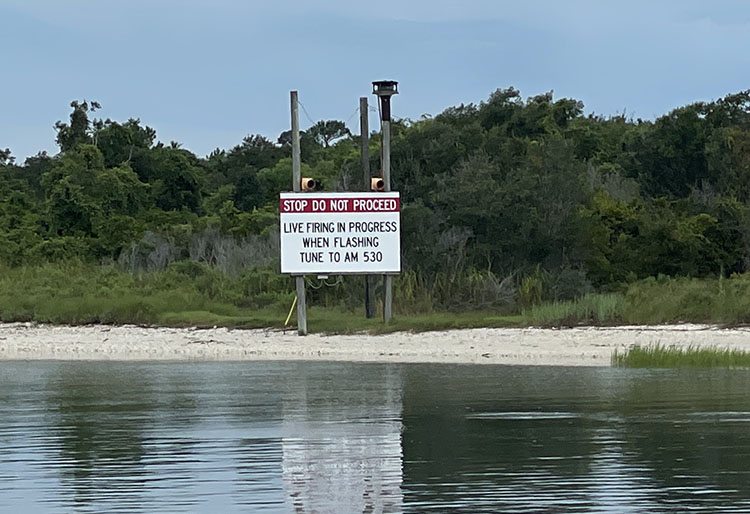
We stopped at two more anchorages before reaching New Bern, NC. Along this route, the ICW goes through Camp Lejeune where the Marines often practice with live ammunition. By reading the notes on our digital charts I learned that the ICW is often closed in this area due to these live ammo practices. The notes had a phone number, so I called it to see if the ICW would be closed when we planned to pass through. There were no activities planned for the day, so we were clear to pass through Camp Lejeune uninterrupted. It pays to read the chart notes and comments from other mariners. They can be helpful.
We arrived at New Bern Grand Marina on August 18th around 2:45 pm after fueling up at another marina nearby. We were on the outside of a breakwater dock and when the winds came from the East, it got a little rough. There was no other dock space available, so we had to live with the situation. Luckily it didn’t blow from the East all that often. We planned to be here for about a month and then head north to the Chesapeake Bay to explore the area.
Next time; enjoying New Bern, changing plans, more projects, and weather issues.
 Sailing into our next chapter
Happy New Year! Can’t wait for the next chapter. Love, Barbara
>
LikeLike