This is a detailed account of what happened in the early morning hours of Saturday, October 31, 2020, about 20 miles west of Brookings, OR.
We were broad reaching in 10 to 12 knots of wind about 20 miles off the southern coast of Oregon on our way to San Diego. Our intended stop was Eureka, CA to rest and take on fuel. The winds had been steadily increasing from total calm to about 15 knots or so. This was deceiving as we were heading downwind, so the apparent wind was much less as we were running between 6 and 7 knots. I was casually paying attention to the wind speed and boat speed and started to see a trend of quickly increasing speed as we started to surf down the waves. The speed increase came on rather quickly and I realized we were carrying too much sail for the conditions, so I headed straight downwind to blanket the headsail with the main. After the headsail was fully furled, I attempted to furl the main, but there was just too much wind in the sail to do it while heading downwind.
I started the engine and turned the boat into the wind to furl the main. As soon as I turned the boat, the full force of the 20+ knots of wind hit us hard, so I released the mainsheet to spill the wind from the main. By this point, we were being bounced around like a cork, and I started to get seasick as I usually do in these kinds of conditions. My wife, Lynette, was below trying to sleep as I had taken the first watch. I could hear loose objects being thrown about and I could only imagine how Lynette was taking it (later she confessed that she was hanging on for dear life).
I have successfully hove to with our boat many times, but for some reason, I couldn’t hold her in a good position under bare poles. I kept the engine running low and in gear to help hold the boat at about 60º to the wind. I would increase or decrease the throttle to keep the wind gauge pegged at 60º, which wasn’t too difficult to do, even while sick. The ride was rough as the waves were coming from all directions. The seas, as usual in the PNW were quite confused, so I switched tack to see if riding to the other tack would be less rough. I really couldn’t tell the difference, so stayed on this tack for the duration. At least I attempted to see what the opposite tack was like.
Sometime after 2 am the engine suddenly quit. I couldn’t get the engine out of gear, so thoughts of a failed transmission passed through my mind. With the engine gone, I could only hold the boat at about 90º to the wind. In most situations that would not be good, but in these confused seas, we were not broadside to the waves.

I radioed the USCG for assistance and they mustered a crew to come tow us in. They called every half hour to check on our condition and let us know the progress of the rescue boat. When the boat got closer the skipper radioed us for a current position and asked about our condition, the seas, and the boat itself. I assured them there was no water coming in and that we were fine other than quite sick. The skipper let me know that the seas were much calmer about 6nm to the east. Just our luck that we were 6nm too far off the coast.
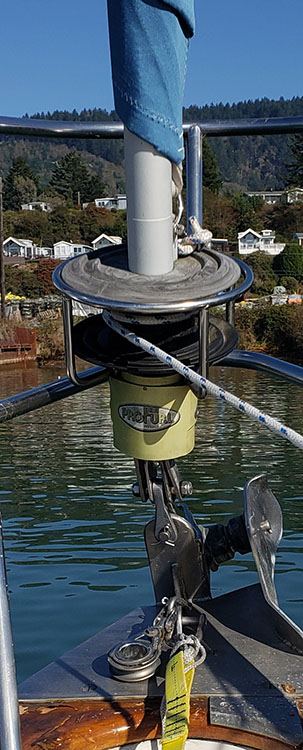
When the USCG rescue boat arrived, they lit up the whole area with their searchlights. It made for an eerie scene. They were going to toss us a line to secure to our bow for the tow, but neither my wife nor I felt strong enough to make our way to the bow. The only option was to have a crewmember land on our boat to secure the line. The first attempt was at the stern, but we are a double-ender and there wasn’t much room for him to land, so they switched to the bow. After a couple of attempts and 2 hard collisions, he was safely onboard. The line was secured, and they started towing us at about 9 knots. A rather loud vibration commenced that none of us could identify, so we slowed a bit to reduce the vibration.
Two and a half hours later we were at the Brookings buoy with the USCG reducing the scope of their tow line to take us over the bar. There were some small boats scattered around the bar fishing, so the skipper asked me to steer our boat directly behind their vessel to keep away from the fishing boats. Once over the bar, they side-tied to us for the final tow to the fuel dock. We tied up around 8 am or so. I was still quite weak but was able to answer questions and accompany the officer on a boat inspection. He indicated that the damage caused by their boat would be covered by the USCG, which was a pleasant surprise to me. He didn’t have any forms with him, so asked me to come by the USCG station in the next few days to pick one up, which I did.
The fuel dock attendant and the USCG personnel were very nice and helpful. They provided information on where to stay, so we booked a room at one of the local hotels. There was a restaurant across the street from the hotel, so we had a late lunch/early dinner and went back to the room to sleep at about 3 pm. We slept until 7 am the next morning. It felt good to catch up on sleep and sleep in a bed again.
The following morning, Sunday, November 1st, we went to the boat. I inspected and took pictures of the damage. Lynette attempted to tidy up the cabin as best she could. When we had docked the day before, I noticed that one of the dock lines was cut short, and a spring line was going under the boat, which was very tight. I was able to loosen the tight line but couldn’t free it. The other spring line had been bound under the tight spring line and when I loosened the tight one, I was able to free the other line. It had not been cut. We had two lines that were good and two lines that had been cut. I assumed that because of how taut the line was that this was what was jamming the transmission in gear. The fuel dock attendant called the boatyard owner, and he came over to discuss hauling the boat out the following day at high tide, around noon.
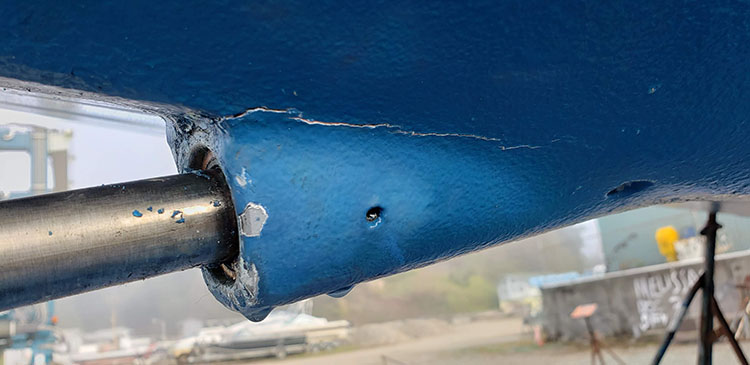
On Monday, November 2nd, we were side tied to a boat and taken over to the travel lift for the haul out. There was no dock at the travel lift so I remained on the boat as it was lifted and walked off the stern when at ground level. As soon as the boat was out of the water, we could see the extent of the damage. This was not going to be a simple cut the line free and drop the boat back in the water project. The dock line had wrapped three times around where the shaft passes through the shaft log. It was so tight that the area around the shaft housing had cracked. We resigned ourselves to the fact that we were going to be in the yard for a while. Figuring fiberglass work and repainting it would be at least a week.
The hotel we were in was a bit expensive, so on one of our daily walks, we checked pricing at several other hotels and found one that had weekly rates and a kitchen for quite a bit less money. The best part is that the hotel was right across the street from the boatyard. We grabbed food off the boat and settled in for what we thought would be a week’s stay at the hotel.
On Tuesday, November 3rd I was able to take the shaft out of the boat and have it spun up on a lathe to see if it was bent. Unfortunately, it was, so I measured it and ordered another one from Portland to replace it. Meanwhile, the fiberglass person ground off the bottom paint and barrier coat around the shaft log to prepare for the fiberglass repair work.
By Thursday, November 5th, I had a new shaft and the fiberglass work was done. I still had to paint 2 coats of barrier coat and 2 coats of bottom paint, plus install the new shaft. I was worried that the strut had been bent and the shaft wouldn’t turn freely, so slipped the shaft into the bearings and was pleasantly surprised that it turned freely. By Friday, November 6th, I had the propeller, line cutter, and zincs all back on the shaft along with the dripless shaft seal. All that was left was to align the shaft and transmission coupler. I was surprised that everything was still in perfect alignment, so I didn’t have to adjust the engine on its mounts.

On Monday, November 9th, I started the painting process with one coat of Pettit Protect barrier coat in the morning. I needed to wait until Tuesday to put the second coat on, so took the rest of the day off. Tuesday, November 10th, had me putting the second barrier coat on in the morning and the first coat of Pettit Trinidad Pro bottom paint on in the afternoon. The timing of the first coat of bottom paint is critical, as it needs to go on before the last barrier coat completely dries for it to bond to the barrier coat. On Wednesday morning, November 11th, I put the last bottom coat on which finished the project.
The boat couldn’t go in the water for 24 hours after the last coat of bottom paint, so we set a time for Thursday morning to launch the boat. I was at the boat by 9 am peeling off the masking tape and getting the boat ready to launch. While removing the tape from the propeller shaft I noticed that the two weep holes that had been at the forward end of the shaft log cutlass bearing had been fiberglassed over. I don’t know why I never noticed it before, but at least I noticed it before the boat was launched. These weep holes provide water flow to lubricate the cutlass bearing and are necessary to prevent burning up the bearing.
The boatyard owner was able to contact the fiberglass person and he came in to drill out the holes. He easily found one hole but missed the second one. I noticed the second hole hadn’t gone through, so I had him come back to explore for it. He finally found it, but now he had to fiberglass over the exploratory holes he made trying to find the actual hole. This was a huge setback, as it would require going back through the entire painting process after the fiberglass had set. I was disappointed that I hadn’t seen that the weep holes were missing back when I started the original painting. The fiberglass person was also disappointed that he had forgotten to clear the weep holes.
Needless to say, we didn’t launch the boat that day. The boatyard owner felt bad for us and said he wouldn’t charge us for anything more, so my yard days were free from that point on. He also gave me the combination for the yard gate so I could work over the weekend and lent me his truck so we could go to the grocery store to get food. We appreciated all he was doing for us.
On Friday, November 13th, I started the painting process again. The goal was to have it done by Sunday, November 15th, and launch the boat on Monday, November 16th. The painting went without a hitch and we launched the boat on Monday morning as planned. I motored for the first time under my own power back to the transient dock. It felt good and we had no issues. We were back on the boat and anxious to head south. We had been in the boatyard for two whole weeks. The incident took two weeks and two days out of our travel time to San Diego, and I was nervous about leaving Brookings so late in the fall. The locals say, “If you don’t leave Brookings by Halloween you’ll be staying until Spring.”
I had been monitoring the weather using PredictWind since we had arrived in Brookings, so was fairly confident of what was to come. We sat through torrential rains and heavy winds at the dock for two days, Tuesday and Wednesday. There appeared to be a small weather window traveling down the coast that was to pass Brookings on Thursday, November 19th. We hoped to catch a ride on that weather window and have it carry us as far south as we could get, and that is exactly what we did.
Postmortem
I have always done postmortems on things that I’ve been involved with to see if I could learn from them, and if mistakes were made, try not to make them again. What did I learn from this incident? First off, don’t leave dock lines on the deck during a passage. Good grief, I’d be a rich man if I had a dollar for every time I’ve heard that since this incident. Yes, it was a bad thing to do, but I had not thought anything of it as we have high gunwales and have never lost a line over the side, even in seas as bad as we had experienced this time. Well, it was an accident waiting to happen and we suffered the consequences for it. That was the first and biggest mistake that I will never let happen again.
I had just finished reading Lynn and Larry Pardey’s book on storm tactics. They are big advocates of heaving to during a storm rather than running with the storm. So, when I turned into the wind my first thought was to wait out the blow by heaving to. This was my second mistake. Not being able to see the sea before me I immediately thought the conditions to be worse than they probably were. Getting sick was a bonus that just added to the situation. If it had been daylight, I might have taken a different approach. Further south as we were rounding Cape Mendocino, we were confronted with almost the same situation; a quickly freshening breeze with a need to reef while going downwind. The big difference is that this was during the day. As soon as we came about the full force of the wind hit us and we were again bouncing around like a cork. The difference here is that I could see the seas hitting us and saw them for what they were. We reefed and came about to continue our downwind sail under reefed sails. It really would have been that simple that fateful night if I had done the same thing, but without the ability to see, I made these two mistakes that cost us about $12,000 and two weeks.
 Sailing into our next chapter